The ring around this galaxy comes from another galaxy
Euclid’s Einstein ring puts two very different cosmic distances into a single picture.
Space & science | 4-minute read | Checked 8 October 2026
Look at the bright centre, then the thin ring around it. They seem to belong to one object. But the light began its journey in two different galaxies.
The ring is light from a galaxy much farther away, bent and stretched by the gravity of the nearer one. This is an Einstein ring, captured by the Euclid space telescope.ESA’s image explanation
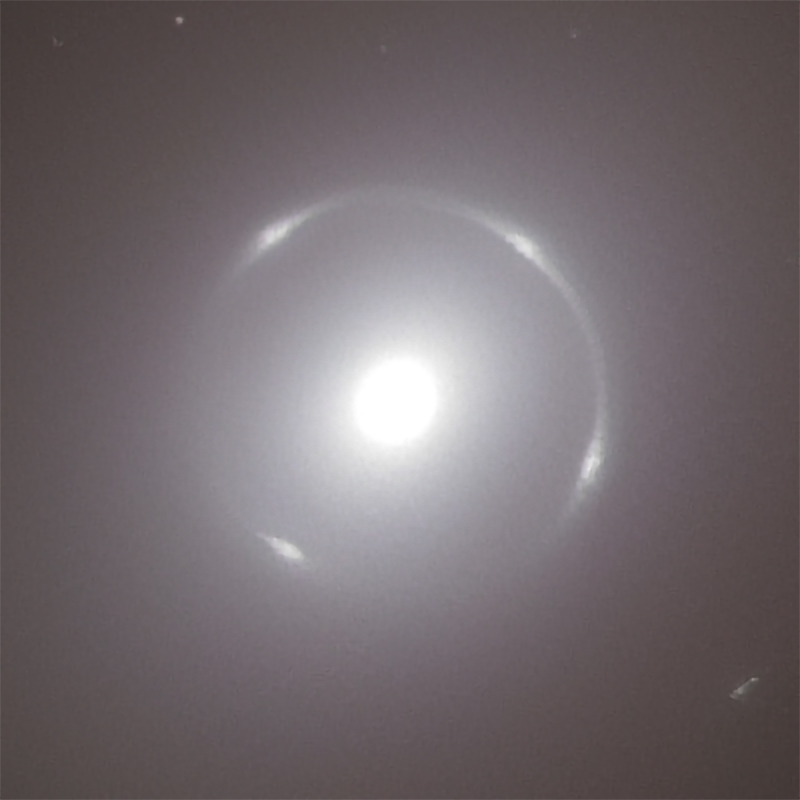
Observed image: the centre of NGC 6505. The bright core belongs to the foreground galaxy; the ring is an image of a background galaxy. This is ESA’s processed telescope image, not an artist’s impression. Full image credit below.
Two galaxies, billions of light-years apart
The foreground galaxy is NGC 6505, about 590 million light-years from Earth. ESA places the background galaxy at about 4.42 billion light-years away. They sit close together on the screen, but far apart in space.
NGC 6505 has been known since 1884. The ring went unnoticed until Euclid’s test observations in September 2023, when scientist Bruno Altieri spotted the first clue. Remarkably, that initial image was deliberately out of focus. Further observations revealed the ring clearly; the discovery was announced on 10 February 2025.ESA’s announcement
The ring had not suddenly appeared. Astronomers had gained a better view of something already there. Even a familiar galaxy could hold an unfamiliar sight.
Why does the distant galaxy look like a ring?
Mass curves spacetime, changing the paths light takes through it. A galaxy can therefore alter the image of an object behind it without any glass lens. Astronomers call this gravitational lensing.
Light from the distant galaxy can reach us along different routes around the foreground galaxy. We may see several images of the same object, or an image stretched into an arc.NASA’s explanation of gravitational lensing
With the right alignment between source, lens and observer, that extended image forms a ring. Change the alignment or the distribution of mass in the lens, and the result can be separate images or arcs instead. A galaxy behind another galaxy does not automatically make a ring.NASA’s explanation of Einstein rings
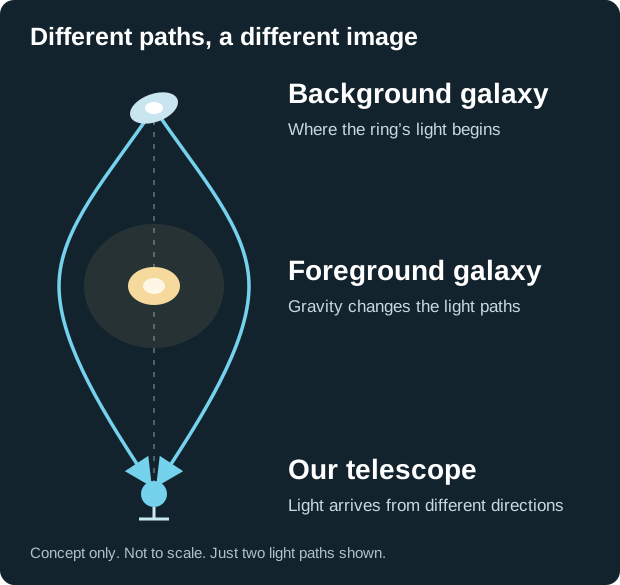
Expand the diagram
Scroll within the diagram horizontally; arrow keys work when focused.
Original explanatory diagram, showing only two light paths. It is neither an observation nor a numerical simulation.
Now look again at the photograph. The ring is uneven, with four particularly bright patches. It is not a perfect, uniform circle drawn around a dot. Those details are part of the distant galaxy’s distorted image, and they give researchers more than a beautiful outline to work with.
The ring can help weigh the galaxy in front
Lensing turns a distortion into a measuring tool. The amount of bending carries information about the mass responsible for it.
A galaxy’s brightness mainly tells us about material that emits light. Gravity also responds to material that does not. Lensing therefore offers a way to investigate mass that would be missed by simply adding up the light.NASA on lensing and dark matter
The NGC 6505 study used spectra, which separate light by wavelength, alongside the images. These help distinguish the background galaxy from the foreground one. Information about stellar motions also helped the researchers test their mass model.
The paper reports about 153 billion times the Sun’s mass inside the ring. More precisely, that is mass projected along our line of sight within the ring’s boundary on the sky. It is not the entire galaxy’s mass, and it is not a count of bright dots in the photograph. It is an estimate obtained by interpreting observations with a gravitational-lens model.Research paper, section 3
What was seen, and what was worked out?
The telescope observed a pattern of arriving light. The shape of that pattern, together with separately measured spectra, supports the interpretation of two galaxies at different distances forming a gravitational lens.
Working out exactly how much mass lies where is a further step, involving models. The team’s research institution describes the detailed modelling needed to reproduce the lensed image. Photographing a striking ring does not, by itself, identify what dark matter is made of.Max Planck Society’s account
Look once more at the centre and the ring. The nearer galaxy is doing two things at once: shining with its own light, and changing our view of a galaxy behind it.
Some of the lenses that help us see farther into space are already out there, made from galaxies.
Sources and image credit
The links above lead to the research paper and primary material from ESA, NASA and the researchers’ institution. This article explains a discovery announced in February 2025; it does not present it as new in 2026. Distances use ESA’s public-facing figures.
- Research: C. M. O’Riordan et al., “Euclid: A complete Einstein ring in NGC 6505”, Astronomy & Astrophysics 694, A145 (2025). Full paper / DOI
- Photograph: Close-up of the Einstein ring around galaxy NGC 6505. Credit: ESA/Euclid/Euclid Consortium/NASA, image processing by J.-C. Cuillandre, G. Anselmi, T. Li. CC BY-SA 3.0 IGO. Published image reproduced without alteration. No endorsement by ESA or the credited organisations is implied.
- Diagram: created for this article as an explanatory illustration, separate from the photograph.