Why invest if you already save? Start with when you need the money
Investing can offer a chance for growth beyond what savings earn, but you may get back less than you put in. Before comparing funds, separate money you will need soon, money for unexpected expenses, and money you can leave untouched for a much longer time. Keeping money available is a useful job in its own right. Choosing to wait before investing can be a reasonable result of this exercise.
A payment date changes the question
Consider a made-up example. You have saved for a move in three months and are also setting money aside for a home renovation many years away. The moving company will need payment on a fixed date. The renovation could be delayed or reduced. These examples describe no real person's finances, and the dates are not investment rules.
Now imagine putting the moving money into an investment that falls in value shortly before the bill arrives. Being confident about its distant future does not fill the immediate shortfall. You would need another source of money, a smaller bill, or more time. The moving company is unlikely to wait for a market recovery.
That is why the SEC's guide to risk tolerance ties investment choices to goals, timing, and your response to possible losses. A useful starting question is: “What would happen to this plan if the money were worth less on the day I needed it?”
Why consider investing at all?
Saving protects your ability to meet expenses. Over a longer period, however, you may also want your money to buy more in the future. Stock ownership, for example, can provide gains when share prices rise and may provide dividends. Prices can also fall, and dividends are not guaranteed. The SEC's risk and return explanation describes both the opportunity and the possibility of loss.
There is another distinction: an account balance and what it can buy. If the prices of the things you need rise faster than your savings grow, the same savings will cover less of those purchases. Your balance might increase while its purchasing power falls. This is a conditional explanation, not a statement about today's inflation or interest rates.
Seeking investment growth is one possible response to a distant goal. It does not ensure that you will beat inflation, or even recover the original amount. Higher potential returns come with risks; accepting those risks does not entitle anyone to a reward.
Give the money three different jobs
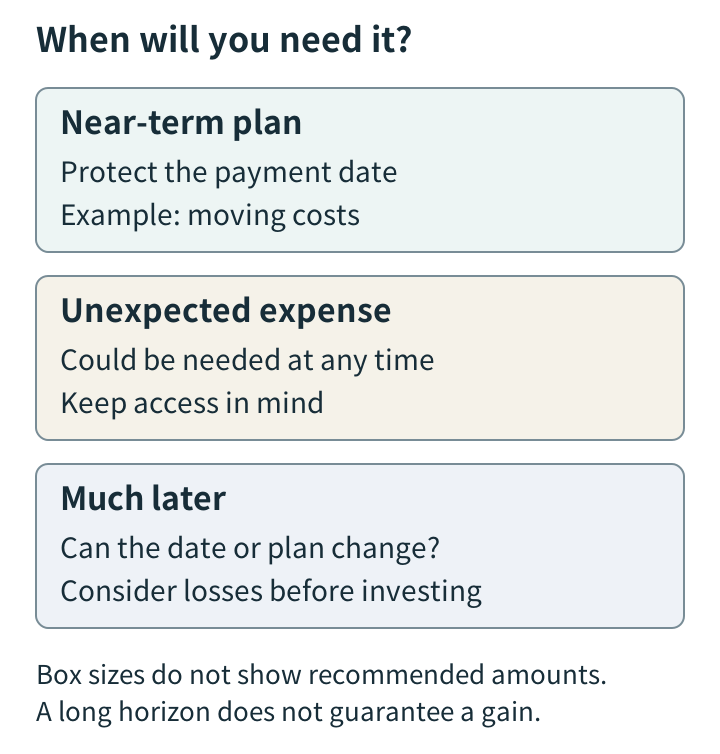
For planned expenses coming soon, concentrate on having the needed amount available when payment is due. In the moving example, a higher possible return offers little help if a loss makes the deposit or moving bill unaffordable.
For unexpected expenses, the date is unknown. A broken refrigerator or an interruption to income could create a need much earlier than a long-term plan suggests. Money reserved for that possibility is already serving a purpose, even during an uneventful month. The SEC's emergency-savings guidance discusses keeping accessible savings for such disruptions. This article does not prescribe a universal number of months or a fixed amount.
For money intended for a much later goal, there may be room to consider investments whose value fluctuates. First distinguish money that truly can remain invested from money that merely has no label yet. An unassigned balance might still need to cover repairs, annual bills, or a change in plans.
Expand the diagram
Scroll within the diagram horizontally; arrow keys work when focused.
Figure: Three purposes, not three required accounts or recommended proportions. An emergency can arrive before either planned goal.
Being able to sell does not protect the amount
Two questions matter when money must become spendable: how much will remain, and how readily can you get it? An investment may be easy to sell but worth less than its purchase price. Another may be difficult to sell when you want to, or involve withdrawal restrictions or costs. The SEC's liquidity explanation describes that access risk.
For a real product, check its sale, withdrawal, and payment terms before relying on it for a deadline. A button labeled “sell” is not evidence that the required amount will be in your spending account that day. Even a savings product can have access conditions that need checking.
More time gives flexibility, not certainty
A distant goal can allow more time before a sale becomes necessary. It does not guarantee recovery after a decline. The SEC's asset-allocation guide treats both time horizon and the ability and willingness to accept losses as relevant. There is no date at which every investment becomes safe.
Return to the fictional renovation. Could you genuinely postpone it if the invested money fell? Would the smaller balance still leave essential spending covered? If the answer is unclear, the flexibility you imagined may not exist. The fact that someone else can wait tells you little about this particular goal.
You do not need to choose a fund to complete this first decision. Keeping the money in an appropriately accessible savings arrangement while clarifying its purpose can be a considered choice. Investing and saving can also coexist, with different money serving different needs.
One useful step today
Choose one planned expense and write one line: “I expect to need this money for ___ around ___.” An approximate date is enough to begin. If you cannot name the date, write “uncertain” rather than treating the money as automatically available to invest. That line gives your next question a concrete starting point.
Sources checked October 11, 2026. General education for US adult readers, not individualized financial advice or a product recommendation. No account, trading, or withdrawal tests were performed. Product terms and official guidance should be rechecked before relying on them.