You have started investing. What is worth reviewing?
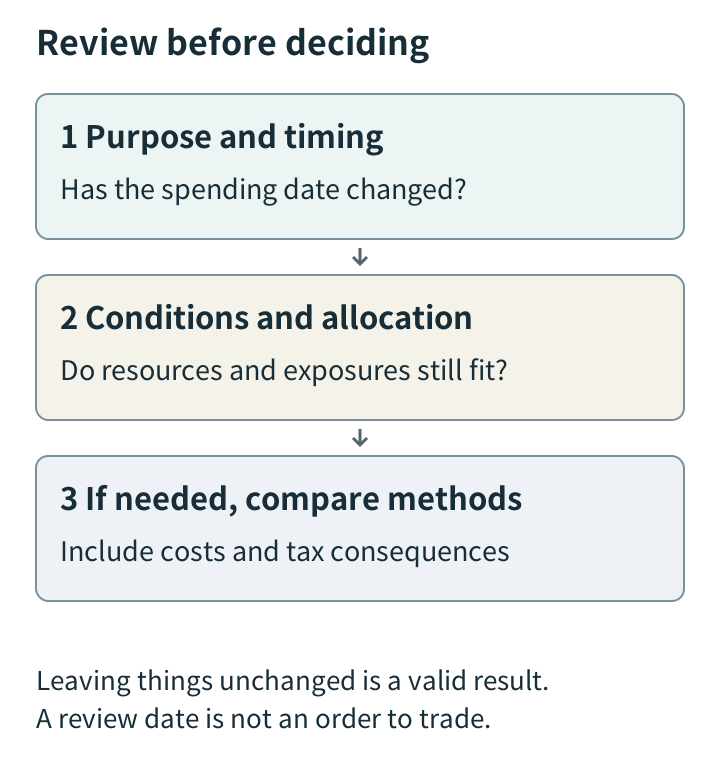
Review when you need the money, whether your financial circumstances have changed, how your holdings compare with your intended mix, and whether a fund's terms have changed. For today, choose a review date and one question to answer on that date. An appointment to review is not an instruction to trade.
A balance does not explain your plan
After you start investing, the account balance becomes an easy number to check. Green can feel like permission to continue; red can feel like a demand to do something. Neither color tells you when a bill will arrive or how much loss your plans can absorb.
Imagine that money intended for a home improvement many years away is now needed next year because equipment failed. This is a fictional example. The new deadline is a reason to revisit the plan even if markets have barely moved. You can investigate the changed spending need without predicting tomorrow's prices.
A useful review therefore begins with the conditions behind your decision. The goal is to understand whether the investment still fits those conditions, not to produce a transaction every time you look.
Check the purpose before the percentages
Write down what this money is for and when you expect to use it. Ask whether the date is flexible, whether your income has changed, and whether accessible savings still cover the unexpected needs you planned for. No universal emergency-reserve amount follows from this checklist.
The SEC's risk-tolerance guidance connects investment choices with goals, timing, and possible losses. A willingness to wait through uncomfortable markets is only part of the question. You also need the financial ability to meet expenses while waiting. Recovery by the date you need the money is not guaranteed.
If your circumstances have changed, the original target mix may need reconsideration. Restoring it mechanically would answer the wrong question. If your circumstances and reasons remain intact, leaving things unchanged can be a legitimate review result.
Notice drift without predicting a reversal
Next, define the pool you are reviewing: money for one goal, or a broader set of assets. Use values from the same date. Switching between a retirement account and your entire financial life halfway through the calculation changes what the percentages mean.
Consider a fictional pool containing $5,000 in stocks and $5,000 in cash. Suppose the stocks rise to $7,500 while cash remains $5,000. The total is now $12,500. Stocks are $7,500 divided by $12,500, or 60%; cash is 40%. A 50/50 mix became 60/40 without another stock purchase.
The amounts, price change, and allocation are invented for arithmetic. They are not a forecast or recommendation. Interest, taxes, and fees are omitted. The calculation establishes that the mix drifted. It does not establish that stocks are overpriced or about to fall.
Rebalancing means moving toward an intended allocation. It is a way to address changed exposures, not a method for identifying a market peak. First decide whether the intended allocation still fits; only then consider whether a deviation calls for action.
Expand the diagram
Scroll within the diagram horizontally; arrow keys work when focused.
Compare ways to adjust
Suppose, just for the fictional example, that returning to 50/50 remains the chosen plan. Ignoring costs, taxes, and further price changes, selling $1,250 of stocks and holding the proceeds in cash leaves $6,250 in each category.
Alternatively, adding $2,500 of genuinely available new cash would leave $7,500 in each. Redirecting future contributions can also change the mix over time. These paths require different amounts of new money and different transactions; they are not interchangeable instructions.
The SEC's allocation and rebalancing guide identifies selling, directing new money, and changing ongoing contributions as possible approaches, while flagging fees and tax consequences. New contributions may be insufficient to correct a large deviation quickly. Prices can also move while you wait. Selling can change the mix sooner, but its costs still matter.
Do not pull money away from an upcoming bill merely to make a percentage look tidy. The arithmetic is a comparison tool, not a new priority over the purpose you checked first.
Identify the account before estimating tax
In a US taxable brokerage account, selling an investment can realize a capital gain or loss. The amount sold is not itself the gain: the IRS explains the role of adjusted basis and sale proceeds. Individual tax treatment depends on details beyond this example, so no tax bill is calculated here.
A traditional IRA follows different rules. The IRS states that amounts in a traditional IRA, including earnings and gains, generally are not taxed until distributed. Reallocating investments inside an account and withdrawing money from it are different actions. Do not transfer the taxable-account example to a retirement account, or assume every retirement arrangement has identical rules.
For the fund itself, compare the current prospectus, shareholder report, and change notices with what you thought you bought. Has the investment objective, benchmark, currency policy, or fee schedule changed? The SEC's mutual-fund guidance points readers to the fund's prospectus and most recent shareholder report. Include transaction costs relevant to your actual product and broker rather than assuming a headline ongoing fee covers everything.
Make the next review small enough to do
A calendar date, perhaps an annual review, can be a reminder. It is an example, not an optimal frequency for everyone. A substantial change in income or spending needs can justify reviewing the plan before that date. Neither approach requires making a trade at every review.
Start with one line: “On this date, I will check whether the date I need this money has changed.” Record the answer, including “no change.” You can add allocation and document checks as needed. The useful result is a clearer reason for your next decision, which may be to keep the plan as it is.
Sources checked October 11, 2026. Recheck current tax guidance and product terms before publication or action. This is general education, not tax advice, market timing, or an individualized trading recommendation.