Tomioka Silk Mill: a day trip through three historic buildings
Why did making a fine silk thread require such large buildings? Take that question to Tomioka Silk Mill in Gunma. Three buildings give a visit a useful focus: the East Cocoon Warehouse for storing the raw material, the Reeling Hall for turning it into silk, and the West Cocoon Warehouse for understanding how an old factory can remain in use as a heritage site.
This is a good day trip for readers who enjoy industrial design, materials, or the workings of a factory. Give the mill the main part of the outing, with a meal in town and time to return to a detail that catches your attention.
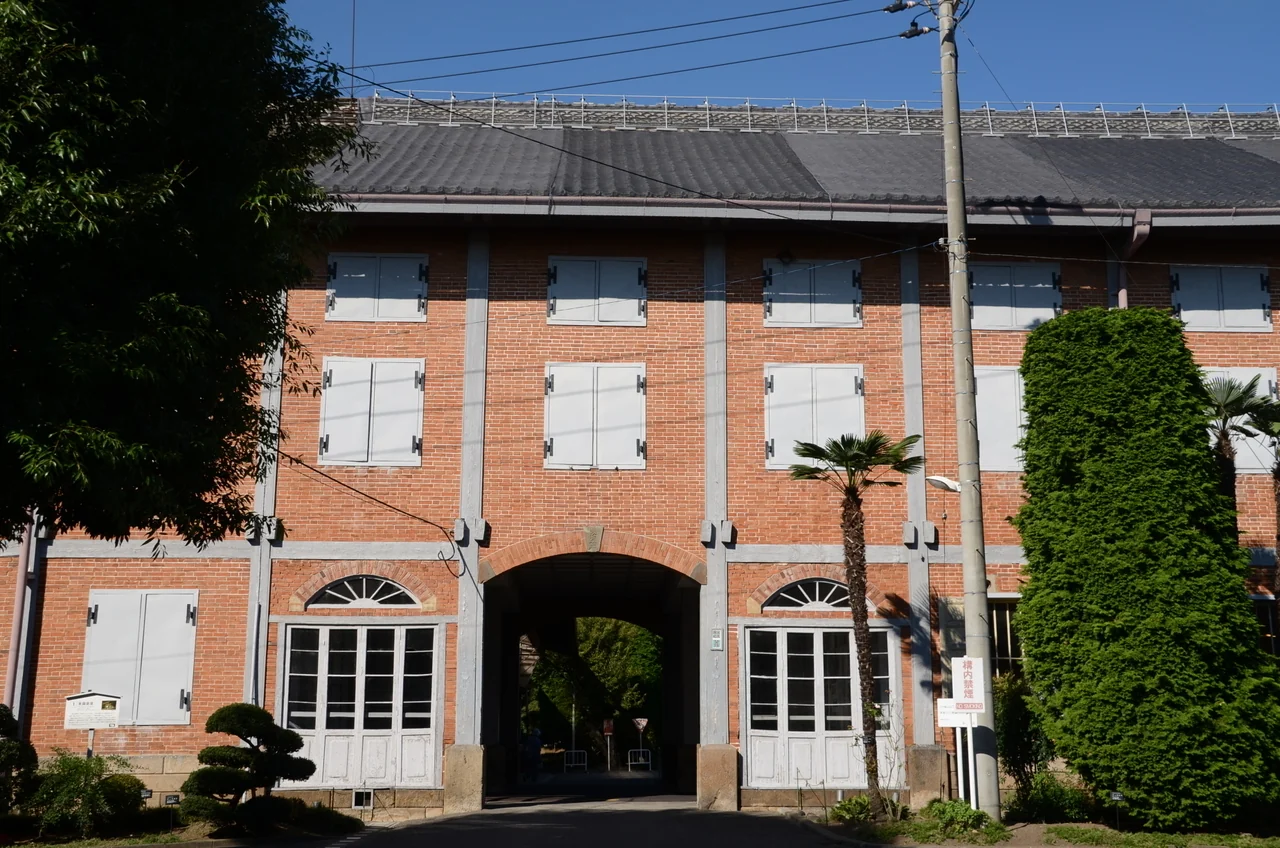
Front of the East Cocoon Warehouse: compare its brick panels and timber framing with the observation diagram below. 画像提供 富岡市 (Image courtesy of Tomioka City; official free-download library, entry dated 14 February 2016; capture date unconfirmed). This is a supplied archive photograph, not a visit made for this article or proof of today’s entrance and access arrangements. Delivery copy: proportionally resized where needed and converted to WebP; no new crop, retouching or generated content. Archived source file is unchanged.
Understand what “reeling” means
The mill began operating in 1872 as a government model factory. Its purpose included producing better raw silk and training women who could take the technology to other parts of Japan. The mill’s history
Raw silk is the thread stage of production. Cocoons are heated in water so their filaments can be drawn out; several filaments are gathered into one thread. Keeping that small operation in mind makes the scale of the warehouses and work floor more interesting. Tomioka Silk Promotion Organization’s explanation
The buildings also carry a history of collaboration. Japanese carpenters worked from French designs, combining timber frames with brickwork. Look for the relationship between the two materials as you move through the site. Japan Tourism Agency background
Three buildings, three questions
Open the original three-building observation diagram
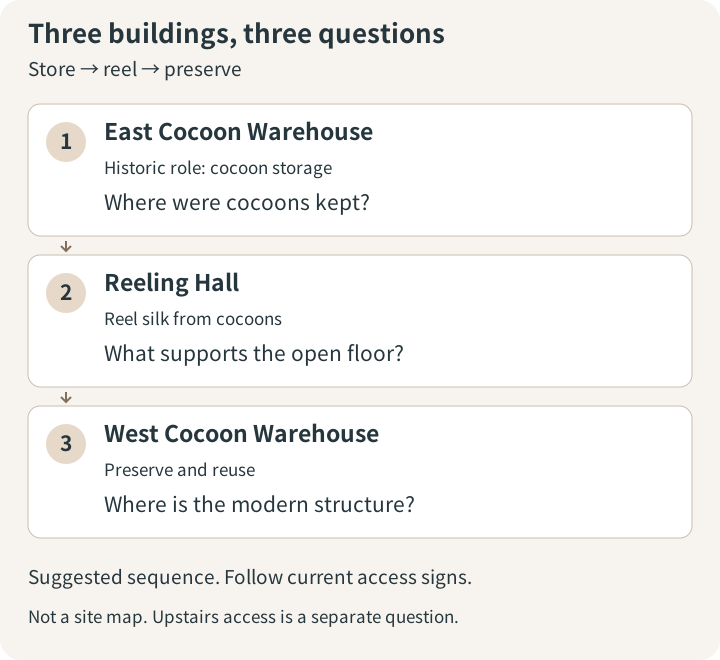
Compare the three buildings in the mill’s official illustrated visitor guide before travelling. A photograph does not establish that every pictured space is open on your date; follow the on-site access signs.
The diagram suggests an order for looking. It is not a site map or a scale drawing. Follow the mill’s signs and the areas open on your visit.
1. East Cocoon Warehouse: where were the cocoons kept?
The East Cocoon Warehouse (東置繭所) is about 104 metres long. Dried cocoons were stored upstairs; offices and work areas occupied the ground floor. Let your eye travel along the building before focusing on an individual window or section of wall. Its length gives the raw material a presence that a spool of silk alone cannot convey. Official building description
Keep this part of the visit to the exterior and open ground-floor areas. The former storage floor is a historical function to understand, rather than an assumed part of your route: an official notice for a special tour including the East Warehouse’s normally closed upstairs is now marked as ended. Access notice
2. Reeling Hall: what supports the open work floor?
In the Reeling Hall (繰糸所), look up before concentrating on the equipment. Roof trusses allowed the central work area to remain free of supporting columns. Follow the roof structure with your eyes, then look back at the space beneath it. The useful question is how the building accommodated work. Japan Tourism Agency architecture guide
Keep the dates of the building and machinery separate. Automatic reeling machines introduced in the 1960s remained in use until production stopped in 1987. The city’s cultural-tourism plan describes the hall as preserving those machines in their stopped state. This brings decades of changes in manufacturing into the older building. Machine history, city plan, page 15
For help with the process, the mill lists animations inside the hall covering silk production and the development of reeling technology. Choose one operation, such as drawing out or winding the thread, and then look for the corresponding equipment. The film becomes a way into the machinery. Display information
3. West Cocoon Warehouse: where is the modern structure?
At the West Cocoon Warehouse (西置繭所), shift your attention to conservation. Work completed in 2020 introduced a glass multipurpose hall on the ground floor, using steel installed for structural reinforcement. Official conservation information
Look for the meeting of older timber and brick with newer steel and glass. What has been kept visible? What has been added to support present-day use? Comparing this with the East Warehouse gives you a second way to read an industrial building, through the work required to keep it useful.
This suggested route stays with the open ground-floor areas. The separate special-access tour of the north side upstairs is advertised for 25 July–29 November 2026. It is outside the ordinary route; do not assume winter or following-year access. Official access notice
Reach Tomioka through Takasaki
From Tokyo Station, choose a Joetsu or Hokuriku Shinkansen service that stops at Takasaki (高崎). JR East’s Takasaki timetable page identifies the services and return direction toward Tokyo. Check the stop pattern of the train you choose.
At Takasaki, follow the west-side connection to Joshin Dentetsu, the private railway serving Joshu-Tomioka (上州富岡). The mill’s official guidance estimates about 40 minutes on this local rail leg, followed by a walk of about 15 minutes from Joshu-Tomioka Station. Save a return departure toward Takasaki before starting your visit. Local access, return timetable
If you are arriving in Japan, these are straightforward routes to the Tokyo starting point:
- Haneda Airport (HND): Tokyo Monorail to Hamamatsucho, then the JR Yamanote Line to Tokyo Station. The operator’s route coverage confirms this connection.
- Narita Airport (NRT): a Narita Express service to Tokyo Station, followed by a separate Shinkansen journey to Takasaki.
Treat the airport transfer as arrival planning. For an unhurried mill visit, choose a day after settling into Tokyo or Takasaki rather than building the outing around an uncertain flight arrival. No airport-to-mill connection time is assumed here.
Make the practical choices once
As rechecked on October 11, 2026, Japan time, the mill’s standard hours are 9 a.m.–5 p.m., with last admission at 4:30 p.m. Its regular closure is December 29–31. Check current visitor information and notices for your date. The official guide describes a mainly exterior visiting route. Bring rain protection and do not assume unrestricted interiors in all three buildings.
Individual visits need no advance reservation. The mill suggests about one to one-and-a-half hours for a visit; leave more room if you want explanation and a second look. Meals belong before or after the visit, since eating on the grounds is restricted. Visitor FAQ
For an adult making the return journey from Takasaki, Joshin Dentetsu lists a combined rail-and-admission ticket at JPY 2,200. It includes one Takasaki–Joshu-Tomioka return and mill admission. The separately purchased total is JPY 2,620: JPY 1,620 for the return rail journey and JPY 1,000 for admission. The combined ticket is sold at Joshin Dentetsu’s Takasaki and Joshu-Tomioka stations. Choose it before buying overlapping tickets; Tokyo and airport travel, meals, and paid guiding are additional. Operator’s ticket details, in Japanese
For independent English-language interpretation, the mill offers a free smartphone audio-guide app, including the West Warehouse. Bring earphones; data charges remain yours. Audio-guide information
On the way back, try describing one building feature and the job it did. Storage space, an open work floor, or modern reinforcement: each gives you a specific answer to why this factory is worth visiting.
Operating conditions rechecked October 11, 2026, Japan time; historical background retains the original source review. This is a researched visiting plan, not a first-hand travel account. No particular travel connection, on-site display operation, or day-specific access was tested.