A rainbow can be a full circle. Why do we usually see an arc?
Imagine completing the curve of a rainbow below the horizon. The familiar arch belongs to a much larger shape: a circle of viewing directions centered on the point opposite the Sun. From the ground, we usually see only part of it.
That does not mean a glowing lower half is always hiding underground. Sunlit droplets must send light toward your eyes along those directions. The surprising part is that you help define the shape. A rainbow belongs to the relationship between the sunlight, the drops, and the observer.
Your shadow points toward the center
If sunshine breaks through while rain remains in another part of the sky, face away from the Sun. Look toward the sunlit drops. There is no reason to look directly at the Sun to find a rainbow.
The direction exactly opposite the Sun is called the antisolar point. It marks the center of the rainbow's circle. When your shadow is visible, the direction toward its head gives you a useful clue. NASA describes the rainbow's geometric center as the antisolar point. NASA: Shadow and Rainbow
Think of an imaginary line extending from the Sun, through your eye, and onward in the opposite direction. That line is the axis around which the rainbow's shape is organized. It does not identify a physical target sitting at the center of the rain.
The circle is an angle, not a ring of water
Sunlight bends as it enters a water droplet, reflects inside, and bends again as it leaves. Different wavelengths take slightly different paths. For the main, or primary, rainbow, the red outer edge appears about 42 degrees from the antisolar direction. That is an angular radius measured at your eye, not a diameter or a distance to the rain. National Weather Service: how rainbows form
Here is the geometric step. Take directions about 42 degrees away from the axis and continue all the way around it. They trace a circle in your view. In three dimensions, those lines form the surface of a cone with your eye at its tip.
The drops do not have to gather into a circular arrangement. Drops at different distances can contribute if their positions and illumination send the appropriate light toward you. This is why a rainbow can look neatly organized even though the rain itself is scattered through a volume of air.
Open the circle-and-horizon diagram
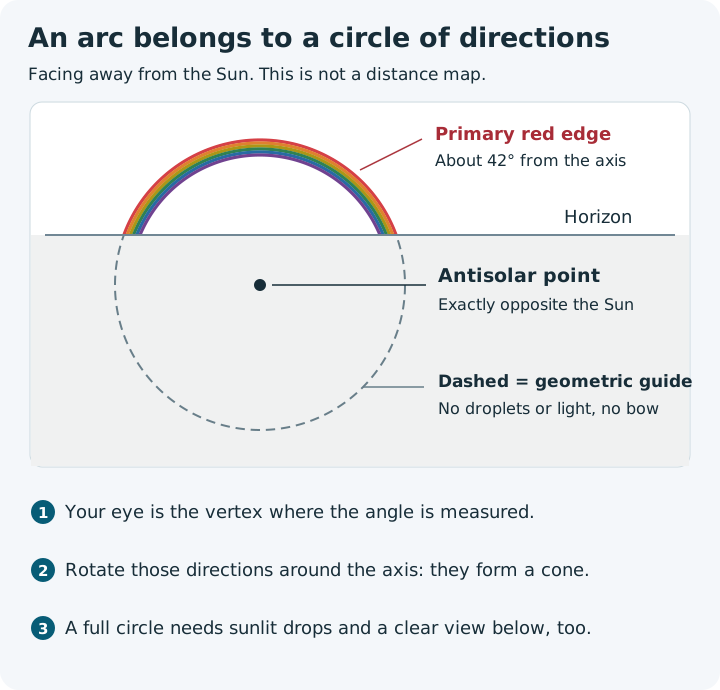
The dashed portion completes the geometry. It does not promise visible light below the horizon. The diagram is a sketch of directions, not a map showing how far away the rainbow is.
A higher Sun pushes the arc downward
When the Sun is above the horizon, the antisolar point is below it. As the Sun rises, that center moves farther down. Less of the primary circle remains above a level horizon.
For a simple example, put the Sun 20 degrees above a level horizon. The top of the primary red edge would be roughly 22 degrees high: about 42 minus 20. This is a geometric estimate, not a visibility forecast. A hill, a building, missing droplets, or blocked sunlight can still remove part of the view. The National Weather Service describes the same relationship between a low Sun and a higher arc. NWS rainbow geometry
This also explains why the ordinary rainbow is not always a perfect semicircle. You may get a shallow arch, a short fragment, or an unevenly bright section.
An airplane can reveal more, but height is not enough
From an aircraft, you may have a view into the directions that the ground usually blocks. If illuminated droplets are present below as well as ahead of you, a full circle can become visible. The Met Office specifically makes the below-observer droplets and sunlight part of the conditions. Met Office: full-circle rainbows
A window seat is therefore an opportunity, not a guarantee. Likewise, there is no promise that climbing higher will turn any rainbow into a complete ring. Stay in permitted, safe viewing areas; do not approach a cliff edge or lean beyond a barrier to look for the missing portion.
The circle has no fixed endpoint you can reach. As your viewing position changes, the contributing droplets change too. NOAA describes a rainbow as a phenomenon dependent on the observer's position, rather than an object in one particular place. NOAA: what causes a rainbow
The second bow takes a different path
A primary rainbow comes from light reflected once inside the drops. The fainter secondary bow comes from light reflected twice and appears outside the primary. Its color sequence reverses: the primary has red on the outside and violet on the inside; the secondary has red on the inside and violet on the outside. NOAA's explanation of double rainbows
That gives you something specific to look for beyond counting two arches. Compare the facing edges. Two reflection paths produce different angular bands, rather than one bow being an offset duplicate of the other.
Try a three-detail observation
Next time a rainbow appears, note just three things: where the Sun is behind you, whether the visible arc is high or low, and whether a second bow reverses the colors. You can sketch the implied center afterward instead of chasing the ends.
Observe from a safe stationary place. Don't stand in a road or use a camera while driving, and never look directly at the Sun. If you hear thunder, stop watching and move into safe indoor shelter. A patch of sunshine does not make a nearby thunderstorm safe. National Weather Service lightning safety
You do not have to see the whole circle to appreciate it. An ordinary arch already contains the geometry of a much bigger view, with your own eyes at the center of the explanation.
Sources and scope
Official NASA, NOAA, National Weather Service, and Met Office material was checked on October 10, 2026 UTC. The diagram and simple angle example are original explanatory constructions. No photographs were reused, and no observation or optical experiment was conducted for this article.