Why does the same note sound different on two instruments?
A piano and a clarinet can play the same pitch, yet you can often hear which is which. Their sounds differ in frequency balance, in how they begin and fade, and in details such as noise. Listen to the beginning and the continuing sound separately; the note name tells you only part of what is happening.
First make sure “the same note” means the same pitch
Two notes called A can be an octave apart. For this comparison, imagine the same note in the same octave and tuning, played at a comfortably similar perceived loudness. That removes some obvious differences before asking about timbre, the quality we describe with words such as bright, rounded, breathy or metallic.
Frequency is a physical rate of repetition, measured in hertz. Pitch is something we hear. For ordinary pitched tones they are closely related, but a complex musical sound can contain many frequency components while being heard as one note. Pitch is not simply the frequency with the tallest bar in a spectrum. UNSW’s acoustics questions on pitch and complex tones
A recording can add other differences too: room reverberation, microphone position and playback settings. Similar volume is a useful listening condition, not proof that two recordings were made under matched laboratory conditions.
One note can contain several harmonics
For a simple harmonic example, call the fundamental frequency f. Harmonics occur at whole-number multiples: f, 2f, 3f and so on. Their relative strengths can differ even when the fundamental stays the same. Changing the mixture changes the resulting waveform and contributes to a different timbre. UNSW on spectrum, harmonics and timbre
In English descriptions, an overtone is above the fundamental. In this ideal harmonic series, the first overtone is 2f, also called the second harmonic; check which numbering is intended.
A magnitude spectrum puts frequency along the horizontal axis and the strength of each component on the vertical axis. The bars answer a specific question: how much of each frequency component is represented in this example?
Compare hypothetical frequency balances and note envelopes
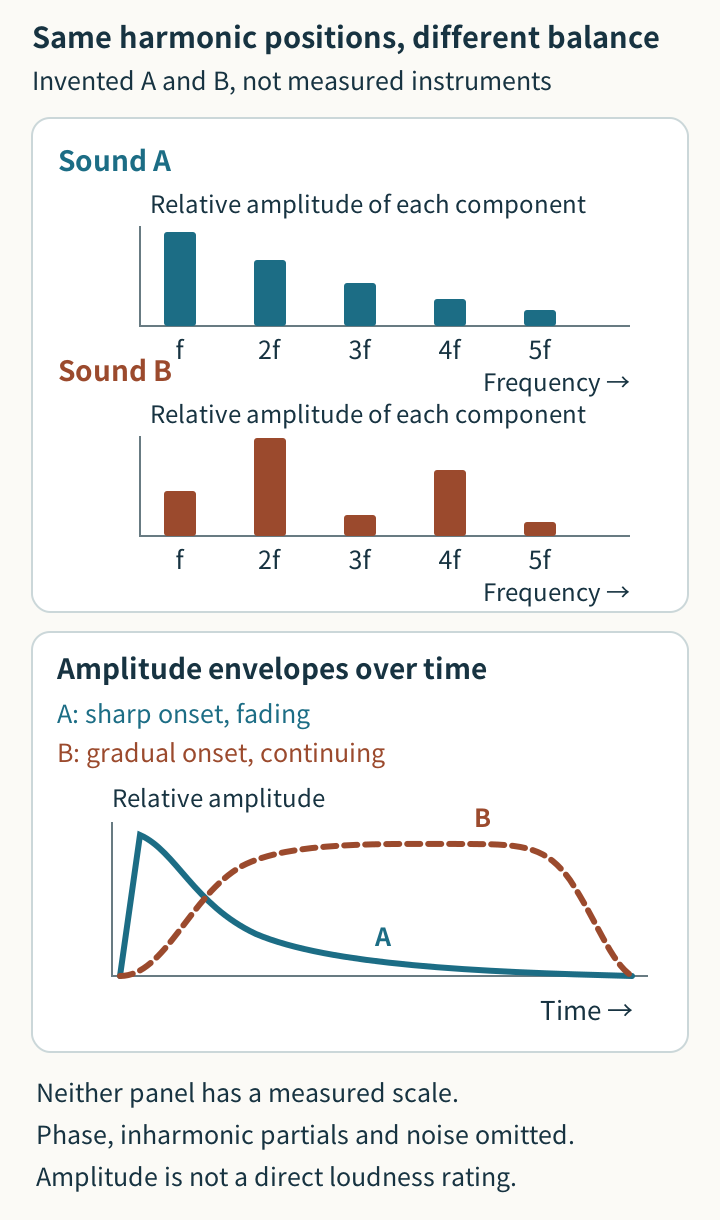
In the upper panel, Sounds A and B share the same harmonic positions but have different bar heights. No actual instruments were recorded to make these diagrams. The values are invented teaching choices, without a measured scale. B is not a clarinet, A is not a piano, and neither is an instrument-identification template.
The fundamental-frequency component does not have to be the strongest. It need not even be present for a listener to perceive a pitch associated with that fundamental; a suitable pattern of higher harmonics can produce the “missing fundamental” effect. That is one reason a neat equation between pitch and the strongest spectral peak will mislead you.
The start of a note carries information
Now picture the amplitude changing over the duration of a note. It may rise abruptly and fade, or develop more gradually and continue while energy is supplied. This overall shape is its amplitude envelope. “Attack” describes the onset; decay, sustain and release are useful further labels, though every sound need not contain four neatly separated stages.
The lower diagram shows two hypothetical envelopes. Its vertical axis is relative amplitude, not a direct measure of how loud a person will judge the sound. The curve is also not the rapid back-and-forth oscillation of the sound wave; it describes the broader change in its size over time.
Short events at the start can include irregular vibration and noise before a more stable tone develops. UNSW’s envelope explanation describes why removing or changing this beginning can change what a listener recognises. Timbre and the shape of a note over time
A simple bar chart of harmonic strengths does not show those changes. Real instruments can also change their frequency balance during the note, so “spectrum” and “envelope” are two useful views of an evolving sound, not sealed compartments that work independently.
Not every component is a harmonic
“Harmonic” has a precise meaning here: a component at an integer multiple of the fundamental. “Partial” is a broader term for a component of a complex tone. Some sounds have inharmonic partials, whose frequencies do not fit that whole-number ladder. String stiffness and the vibration patterns of percussion instruments help explain why the ideal harmonic picture has limits. UNSW on how harmonic instrumental sounds are
Noise is another ingredient. A breathy or scraping contribution can spread energy across a range of frequencies instead of appearing as one clean line. An inharmonic peak and a broad noise contribution are different features; neither is shown in the upper diagram.
Nor does an instrument have one unchanging spectral recipe. The register, playing strength and technique can change its sound. Recognising a typical tone does not mean that every note from that instrument must have the same proportions.
Listen twice, with a smaller question
If you already have access to a recording or an instrument, choose a short, clearly pitched note. Keep the volume comfortable; making it louder is not the goal. On a first listen, attend to the onset. Does the note seem to arrive sharply, swell gently, or begin with breath or a click? On a second listen, attend to what follows. Does it continue steadily, fade quickly, or change colour as it fades?
Write a description before trying to name a cause. “I hear a brief noisy beginning” is a more defensible observation than “I have identified the third harmonic”. Hearing alone does not give you the bar heights in a spectrum, and this exercise is not a blind instrument-identification test.
If two instruments are available, compare the same pitch and similar perceived loudness where practical. If they are not, one instrument is enough: two ways of starting or sustaining a note can give you something specific to notice. These are suggested listening questions, not results of a session conducted for this article.
There is no single winner among the clues
Both frequency balance and time evolution matter, and their importance depends on the sounds and the task. A published study varied spectral and amplitude-envelope features in resynthesised tones; its abstract reports stronger effects from spectral changes in its particular identification tasks. That supports caution about saying the attack always matters most, or that harmonics alone explain everything. Hall and Beauchamp’s study abstract
The next time two instruments play the same note, you have more than a label to compare: the beginning, the continuing mixture and the way the sound ends. One pitch can carry several kinds of information at once.
Sources and verification
Sources were checked on October 11, 2026 UTC. The research abstract, not the full paper, was available for the cited experiment. The diagrams are original hypothetical examples. No audio is redistributed, and no recording, listening trial or spectral measurement was performed for this article.