Tell one small action in a four-panel comic
Draw an open box. Now draw that same box closed. You have a beginning and an ending. The interesting question is what to put between them so someone can follow the action.
In this exercise, you will make four panels and revise one unclear transition. Use paper and a pencil, or a drawing tool you already have. Simple shapes and a rough hand are enough. Four panels are the working limit for this exercise. Your ending can simply complete the action; it does not need a joke or surprise.
Give the comic one job
Start with a sentence that names a visible action: “A hand closes an open box.” Keep the setting small enough to hold in one view. “Pack for a move” would require decisions about several objects, places, and moments. Closing one box gives you something specific to draw.
Write down the starting and ending states before adding dialogue:
- Start: the box lid is raised.
- Finish: the same lid rests horizontally across the box.
The difference should be visible. “The person feels organized” does not yet tell you what changes on the page.
MoMA’s comic-making activity invites readers to make their own panels and imagine what happens before and after a scene. The box story and the four-panel arrangement below are original choices for this exercise. MoMA activity, page 2
Set a route through the page
Draw four equal boxes in two rows. Number them 1 and 2 across the top, then 3 and 4 across the bottom. For this example, read left to right across each row, starting with the top row. If you arrange the panels in a single column instead, keep them in numerical order from top to bottom.
Sketch the first and last panels before filling the middle. Keep the view from the side. Put the lid’s hinge at the left edge of the box, and give the front of the box one small square mark. These fixed details will help identify the object throughout the sequence.
Open the original comic and panel 3 revision
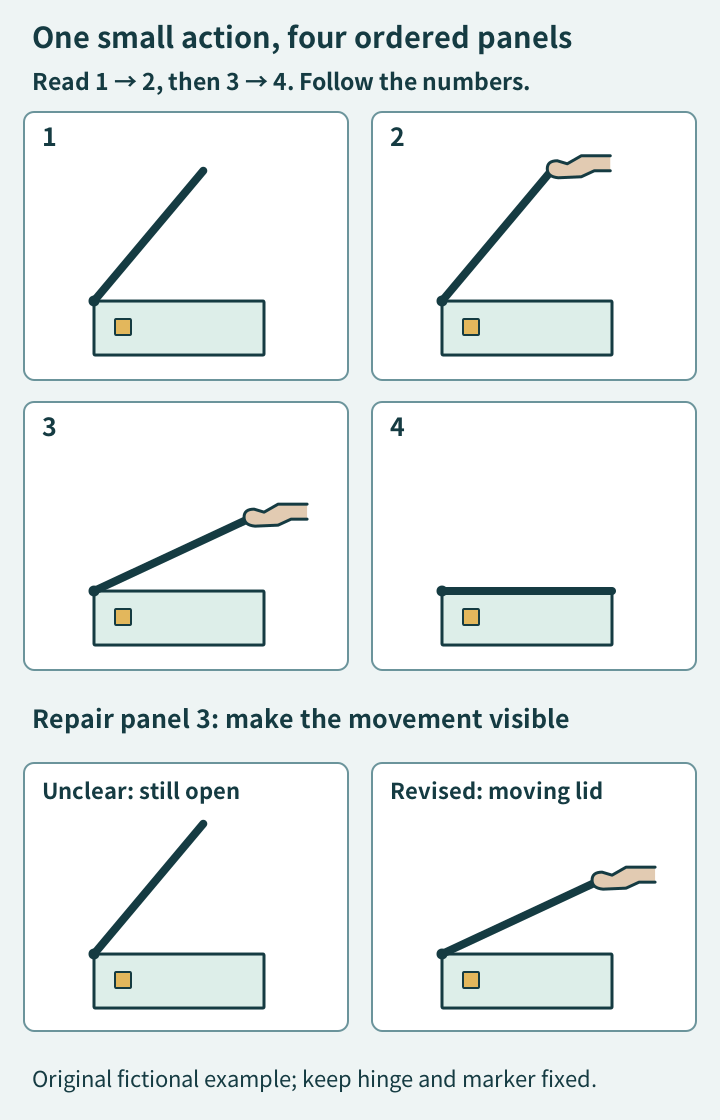
The original illustration has this text equivalent:
- 1: A box sits still. Its lid rises diagonally up and right from the left hinge.
- 2: A hand touches the free end of that raised lid.
- 3: The hand lowers the lid to a shallower angle above the box.
- 4: The lid is horizontal and closed. The hand has moved away.
Keep enough of the scene still
Only the hand and lid need to move. Keep the box, its square mark, and the hinge in the same places. In panels 2 and 3, show the hand touching the same free end. That contact connects the hand’s movement to the closing lid.
You do not have to reproduce every line precisely. Preserve the details that answer practical questions: Is this the same box? Which part is attached? What is moving? A sudden switch to an overhead view would introduce another problem for this first attempt, so save that choice for a different comic.
Repair the missing middle
Imagine a draft in which panel 3 repeats the fully open box, but the hand has disappeared. Panel 4 still shows it closed. The reader may work out the result, but the draft leaves out the movement this exercise is meant to show.
Replace only panel 3. Keep the left hinge fixed and lower the lid partway, with the hand still touching its free end. Its angle now sits between the raised beginning and the horizontal ending. You have added evidence of the change without adding another panel.
The gap between panels is often called a gutter. Here, you leave out most of the lid’s journey across that gap. You do not need a drawing for every possible angle. Compare the images on either side and ask what the reader has to supply. Is the omitted movement a small continuation, or has a necessary connection disappeared?
For your own comic, circle one uncertain transition. Try replacing a repeated pose with an intermediate state before adding a sentence that explains the whole action.
Decide whether words add anything
This example is deliberately wordless. You can keep your version that way, or add a short line when you want information the pictures do not supply. “All packed” could introduce context beyond the act of closing. It would also make a new claim about the situation, so use it only if that is the story you want.
If you add speech, make its speaker and reading position clear. Start with one bubble in a panel rather than crowding several into it. Do not rely on a bubble’s outline alone to carry an essential meaning.
The Japan Foundation’s reading activity asks creators to consider lettering, balloons, and titles as well as pictures and words, and to check comprehension without a spoken explanation. Use that as a question for your own review; this exercise does not require a class or audience. Japan Foundation teaching guide, page 10, in Japanese
Finish one readable sequence
Cover your planning sentence and follow the numbers. Check the pictures against four questions:
- Can you see what changed between the beginning and ending?
- Can you follow the same object throughout?
- Is the important contact or movement visible?
- Is the next panel, and any speech within it, easy to locate?
Make one revision, then give the comic a title such as “Closing the Box.” Keep that finished version. Sharing it is optional. For another attempt, choose a different small action and decide which two middle moments it needs.
Sources checked October 10, 2026, Japan time. The examples are newly devised; their readability has not been tested with readers.