Lettuce freezing in your fridge? Check its location before changing the temperature
Your salad greens have icy patches, but the milk looks normal. Start by finding exactly where the greens were sitting. Move freeze-sensitive food away from a cold-air outlet to the storage area recommended in your owner's manual, and keep the air passages clear. Don't tape over a vent to stop the cold.
If food freezes across several shelves, or the problem returns after those checks, look at the controls and measured temperature. The goal is to stop the unwanted freezing while keeping the rest of your refrigerated food cold enough.
Make a quick map of the problem
Before rearranging everything, note the food, shelf, and position. Was it a clamshell of spinach at the back, a bag in the crisper, or several unrelated items around the compartment? A quick photo can help you compare the arrangement later without leaving the door open.
| What you find | Your next check |
|---|---|
| Only food next to one air outlet freezes | Move delicate food away; check the manual's storage diagram |
| Only a particular drawer is affected | Identify that drawer's purpose and any separate controls |
| Food freezes in several separated places | Check the model's settings and measure the compartment temperature |
| Freezing continues after the recommended checks | Contact the manufacturer or an appliance service provider |
These are sorting questions, not diagnoses. “Spinach froze beside the upper vent; food on the middle shelf did not” is a useful observation. “The thermostat must be broken” is a conclusion you cannot establish from that alone.
An air vent is not a good neighbor for delicate food
On many GE side-by-side models, the damper opening on the left wall can make that part of the top shelf particularly cold. GE advises keeping easily frozen food away from it. That is a useful example of a cold spot, not a diagram of every refrigerator. A French-door or top-freezer model may have a different layout. GE's side-by-side freezing-food guidance
Find your model number and open its owner's manual. Locate the air outlets and returns, then check whether a large container or a floppy produce bag is crowding them. Rearrange the contents so air can circulate. The FDA also advises against overpacking a refrigerator because chilled air needs to move around the food. FDA refrigerator guidance
Consider what changed before the freezing started. Did a grocery run push the greens farther back? Did a new storage bin occupy a previously open space? You can correct an obvious placement problem without immediately changing the temperature of the whole appliance.
Open the placement-check diagram
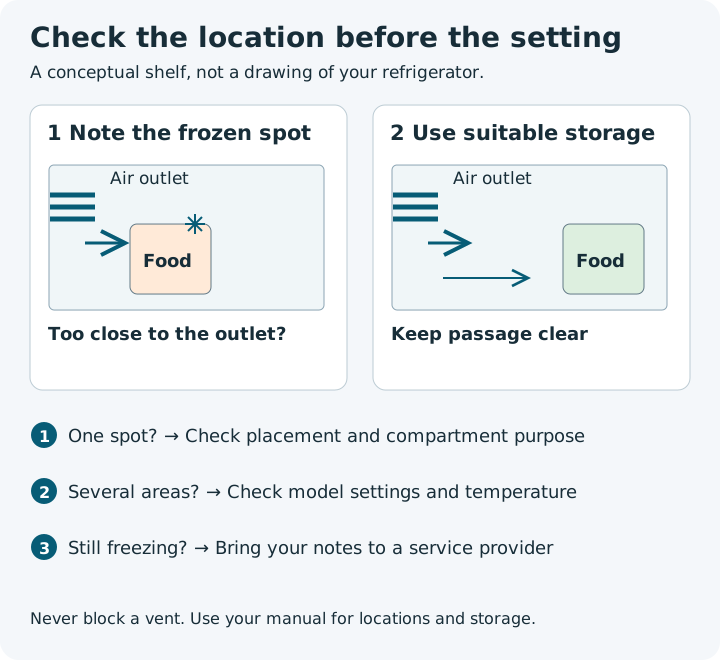
The diagram shows a checking sequence, not a particular refrigerator's construction or required clearance. Use the manual for the actual vent locations. Do not remove an interior panel to search for them.
Read the drawer label before adjusting its control
A produce crisper, a deli drawer, and a convertible compartment do not necessarily have the same job. Check which drawer contains the frozen food and whether its control changes humidity, temperature, or a storage mode. Don't assume a slider marked for produce is a temperature dial.
Keep foods in the compartments appropriate to their storage instructions. Moving a bag of lettuce into the right crisper may be sensible for your model; moving all your perishables to whichever shelf feels warmest is not a sound troubleshooting plan.
For a rented apartment, include the model number and the affected location in your maintenance request. That gives the person responsible for the appliance a clearer starting point than an instruction to replace a part.
A higher number does not always mean a warmer fridge
Some controls display a temperature in degrees. Others use numbers for a cooling setting. On some designs, the freezer and refrigerator controls also interact. Read the instructions for your model before moving either one.
If the manual calls for an adjustment, record the old and new setting and the time. Allow the specified stabilization period before changing it again. GE's general control guidance says to allow 24 hours after an adjustment; use your own model's instructions if they differ. This waiting period is for evaluating the appliance, not permission to leave food at an unsafe temperature. GE's control guide
An appliance thermometer helps check what the refrigerator is doing. Follow its instructions and the refrigerator manual for placement and measurement. A selected temperature on a control panel does not establish the temperature of every food container.
Keep the food-safety limit separate from troubleshooting advice
For US home food storage, the FDA advises keeping the refrigerator at 40°F or below. Treat that as a ceiling, not a reason to aim for exactly 40°F while troubleshooting. Follow your model's recommended setting and verify the actual temperature. Some manufacturer troubleshooting pages quote broader operating ranges; their warmer values are not a substitute for FDA food-storage guidance. FDA's temperature advice
Frozen lettuce tells you something about the lettuce's location. It does not prove that milk, leftovers, or raw meat elsewhere have been stored safely. Nor does finding ice in one package settle whether that food is safe to eat after an unknown storage history. If the appliance cannot maintain safe storage, protect the perishables promptly and follow food-specific safety guidance rather than waiting for a troubleshooting experiment to finish.
Know when you have enough information to call
If food continues to freeze after the manual's placement and control checks, arrange service rather than repeatedly warming the settings. GE's guidance likewise points to service when the suggested steps do not resolve the problem. When GE recommends service
Bring a compact record: model number; affected food and location; whether other areas are affected; control settings; changes and times; and any thermometer readings with their location and method. This can support diagnosis without guessing which component failed.
Success is a better storage arrangement or a clear service request, with safe temperatures maintained. You do not need to buy a new refrigerator just because one bag froze, and you do not need to dismantle the old one to make the first useful check.
Sources and scope
Official GE and FDA guidance was checked on October 10, 2026 UTC. The checklist and schematic are original editorial tools. No refrigerator, thermometer, repair, or food-storage outcome was tested for this article. Use the instructions for your appliance model.