You recognize the word. Can you recall it without looking?
Read one item, then hide the answer and try recalling it before you read it again. Then check what you produced against your learning material and correct anything that differs. You can start by adding that small change to one item you already planned to review.
Imagine a fictional learner revisiting Spanish vocabulary before a trip. Seeing “llave” brings “key” to mind. Later, imagining a request for a door key, they cannot produce the Spanish word. The word is familiar on the page; producing it from a different cue still needs practice. Here, “key” means the object used in a lock, one meaning recorded in the RAE dictionary entry for llave.
Decide what you want to answer without seeing
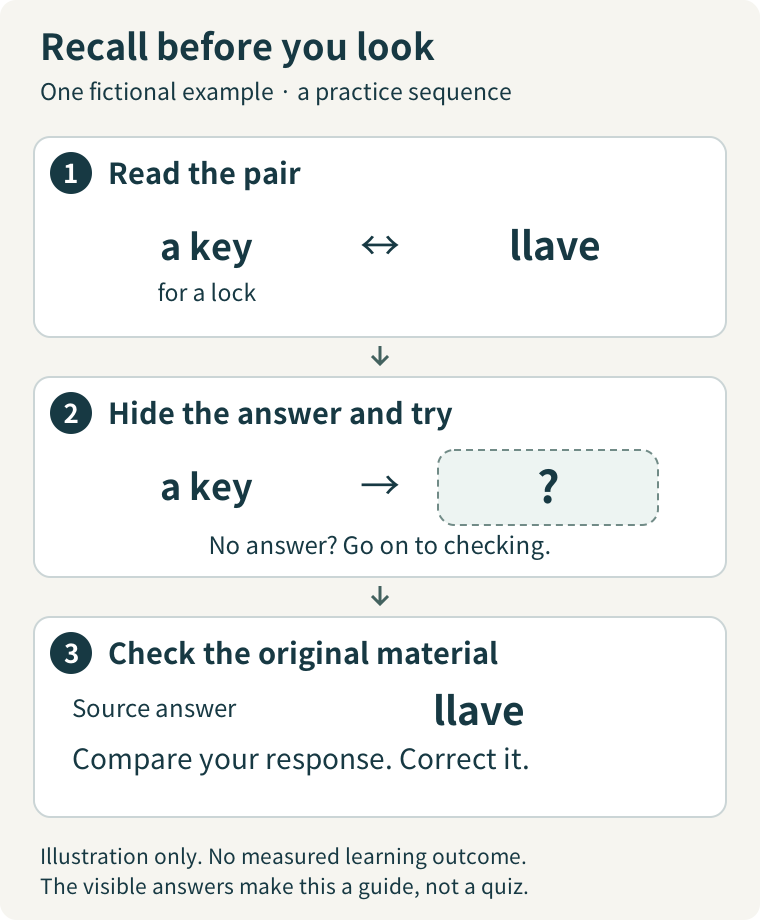
When “llave” and “key” appear together, the page supplies both sides. Cover “llave,” leaving “a key for a lock,” and you must supply the Spanish word yourself. Trying to bring previously learned material to mind is called retrieval practice.
The direction matters to the task you set. Recognizing a Spanish word and recalling Spanish from its meaning use different starting cues. Choose the direction that matches what you want to check. Neither direction is a complete language lesson.
Recalling this word also does not demonstrate pronunciation, sentence construction, or understanding a reply. The immediate aim is modest: retrieve a word before looking at it.
Expand the diagram
Scroll within the diagram horizontally; arrow keys work when focused.
Illustration: read, hide and recall, then check. This original process diagram shows the whole sequence; the displayed card is not itself a quiz.
Recalling can contribute to learning
In Roediger and Karpicke’s 2006 Experiment 1, undergraduates learned short prose passages. Rereading led to better recall after five minutes, but attempting recall after studying led to better recall after two days and one week. The practice tests provided no corrective feedback. Those results concern the passages and conditions tested, not a guaranteed benefit for every learner or task. Primary prose study
A 2008 study used Swahili–English word pairs with college students. Continuing to retrieve words after a first correct response led to better recall one week later than dropping those words from further retrieval. One successful answer need not mark the end of practice. Primary vocabulary study
Neither experiment tested the exact one-word routine below. It is a small editorial suggestion informed by the research, not a proven dose, timetable, or promise about exam scores.
Try it with one item
Use material you already have. You do not need a new app or a complete set of handmade cards.
- Read first. Choose one previously studied word and check its meaning. If it remains unclear, read the explanation or example sentence too.
- Hide the answer. Leave a clear cue, such as “a key for a lock, in Spanish.” Cover nearby notes that reveal the answer.
- Produce a response. Write it or say it. If nothing comes, acknowledge that and move to checking. You do not need to keep guessing indefinitely.
- Open and compare. Check the original material. Notice whether you recalled the wrong word, missed its spelling, or could not retrieve it. Read the correct answer and its meaning again.
“Read first” is not a rule that permits only one reading. Return to the explanation when needed. Being able to repeat an answer immediately after revealing it also does not establish what you will recall next time.
Checking belongs in the routine
A blank response points to something to revisit. It is not a verdict on your ability. A fluent response needs checking too: sounding certain does not make an answer match the source.
In Butler and colleagues’ 2008 experiments, undergraduates answered general-knowledge multiple-choice questions. Showing correct answers improved later performance on initially incorrect items. This provides a reason to include correction, although the experiment did not test this vocabulary routine. Primary feedback study
If you made the card yourself, check that its answer matches the original source. Comparing your response with a copying mistake on a card will not expose that mistake. Give words with several meanings enough context to make the intended answer clear.
Adapt the response method to what is workable. Speak instead of writing, or type if speaking is inconvenient. With audio material, pause after the question and play the answer afterward. These are practical access options, not claims that every format produces identical results. There is no need to add a speed contest.
Keep room for rereading
A 2023 study by Ashby and Zeithamova recruited adults through a university participant system and presented factual statements briefly. On fill-in-the-blank tests two or seven days later, adding both restudy and retrieval after initial study outperformed adding retrieval alone. This qualifies the idea that every further reading should be replaced by a test. Primary study of the combination
For a short passage, you could close the text and answer, “What was its main point?” in a sentence. Then reopen it. Did you use different wording, omit an important condition, or change the meaning? If unfamiliar terms prevented understanding, return to the explanation before asking yourself to recall more.
Being able to state the main point also leaves another question open: can you use it in a new problem? Choose further practice according to that goal. Recalling a term is one part of learning, not evidence of mastery of the whole subject.
For today, choose one item. Answer before looking, check, and use the gap or mistake to decide what to read again.
Sources checked October 11, 2026. This is an explanation based on primary research. Examples and the suggested routine are editorial adaptations. No learner study or retention measurement of this article’s routine was run.