You can solve each type. Why do mixed problems feel harder?
Take three familiar problems that require different methods, put them together, and write the method you intend to use before calculating. This adds a small opportunity to choose a method for yourself. Start with problems whose explanations you have already studied.
Imagine a fictional adult returning to basic math after work. On a page headed “Area of a rectangle,” they multiply the two side lengths and move through the exercises. In a mixed review, they pause. The numbers look familiar, but should they multiply, add, or divide by two?
The page heading previously supplied part of the decision. Without it, there is another question to answer before the arithmetic: what does this particular problem ask for?
The decision before the calculation
Repeating one kind of problem together is often called blocked practice. Mixing problems that call for different methods is called interleaved practice. Here, mixing means arranging familiar math problems so that the method changes between them. You still finish one problem before starting the next.
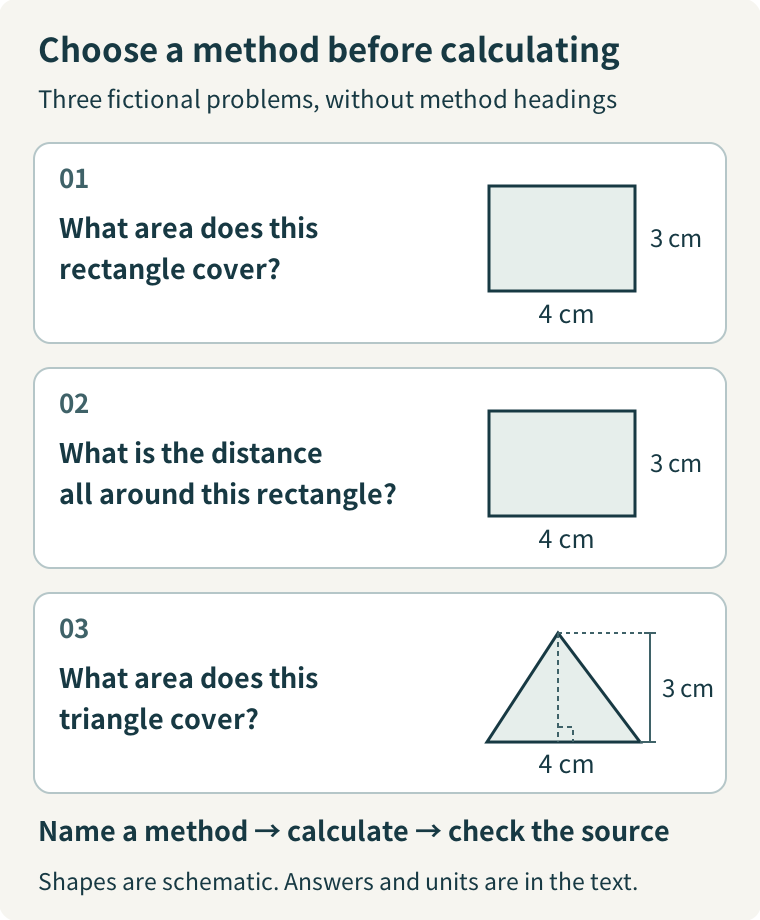
Consider this small, invented set. There are no headings giving the method to use:
- A rectangle is 3 cm by 4 cm. What is its area?
- A rectangle is 3 cm by 4 cm. What is the total length around its outside edge?
- A triangle has a base of 4 cm and a perpendicular height of 3 cm. What is its area?
All three questions contain the numbers 3 and 4. Those numbers alone cannot tell you which calculation to do. The shape and the quantity being requested matter too. The second question asks about the total length around the edge, although it uses the same rectangle as the first.
Expand the diagram
Scroll within the diagram horizontally; arrow keys work when focused.
Illustration: three familiar problem types, with method selection before calculation. This original example is not a worksheet from the research.
Name the method before using it
For the first problem, a useful note is “Find the rectangle’s area by multiplying its length and width.” The calculation is 3 × 4 = 12, and the answer is 12 cm². Square centimeters describe the area covered.
For the second, the note changes: “Find the perimeter by adding all four side lengths.” The calculation is 3 + 4 + 3 + 4 = 14, giving 14 cm. Adding 3 and 4 only once would leave two sides out.
For the third, write “Use half of base times perpendicular height.” The calculation is 4 × 3 ÷ 2 = 6, giving 6 cm². Here the height is perpendicular to the chosen base; an arbitrary sloping side would not be a substitute.
The note can be short. “Add the four sides” is enough to distinguish the second method from the first. There is no need for a formal explanation of every arithmetic step. The purpose is to make the choice visible before an answer or nearby worked solution supplies it.
What the research supports
Rohrer and colleagues’ 2020 study randomly assigned 54 US seventh-grade classes to practice arrangements; the final analysis included 787 students. Over roughly four months, classes received more mixed or more blocked practice. Both groups then had the same mixed review. About a month later, the more-mixed group scored higher on an unannounced test. This was school mathematics, not a test of adult study routines. Primary classroom trial
Mixing also spaced practice of each type and could prompt recall of methods. The study did not isolate these contributions. Nor did it eliminate initial same-type practice. Time spent practicing was not measured, and all 15 teachers reported that mixed assignments took longer. It therefore provides no basis for a time-saving promise. Study discussion and caveats
Results also vary across tasks. In a preregistered 2024 study, 156 children in grades 6–9 received brief instruction in fraction arithmetic and practiced in mixed or blocked order. The researchers found no added benefit from mixing on procedural knowledge. This qualifies a blanket recommendation to mix everything. Primary fraction study, publisher abstract
The three-problem routine here is an editorial adaptation. Neither study establishes that three is an effective dose, or that this routine will improve an adult’s exam score.
Make one small mixed set
Use three problems you already have, one from each of three learned types. Choose ones for which the solutions are available, so you can check your decisions afterward. Copy the full question, including necessary measurements, while leaving out a section title that gives away the method. Keep the solutions out of view until you have tried.
For each problem, write what you are trying to find and the method you will use. Then solve it and compare both the method and the answer with the solution. This is the one change to try: a mixed set with a method choice before each calculation.
If you cannot explain a method even when looking at a worked example, return to that explanation. Practicing several examples of one type can remain part of learning it. You do not need to fill the mixed set with material you have never understood.
Notice where you got stuck
A wrong method and an arithmetic slip call for different kinds of checking. If you wrote “multiply the side lengths” for the rectangle’s perimeter, revisit what perimeter measures. If you chose to add all four sides but wrote 13, review the addition. Getting the numerical answer alone does not show which part went well.
Likewise, a pause before choosing does not by itself show that practice is failing, and extra difficulty does not prove that learning improved. In this small exercise, look at the choice you made and whether it fits the question. Three correct answers today cannot establish what you will remember later.
For your next set, mix three familiar problems and state the method before solving. Keep the task small enough that you can also check what you chose.
Sources checked October 11, 2026. Examples and the three-problem routine are editorial adaptations of primary research. No learner study of this routine was run.