When should you review it again?
Choose one thing you have already studied, and put a return visit on a different day. Start by asking when you expect to need it. A review plan for next week's discussion has a different time horizon from a plan for keeping the knowledge available for months.
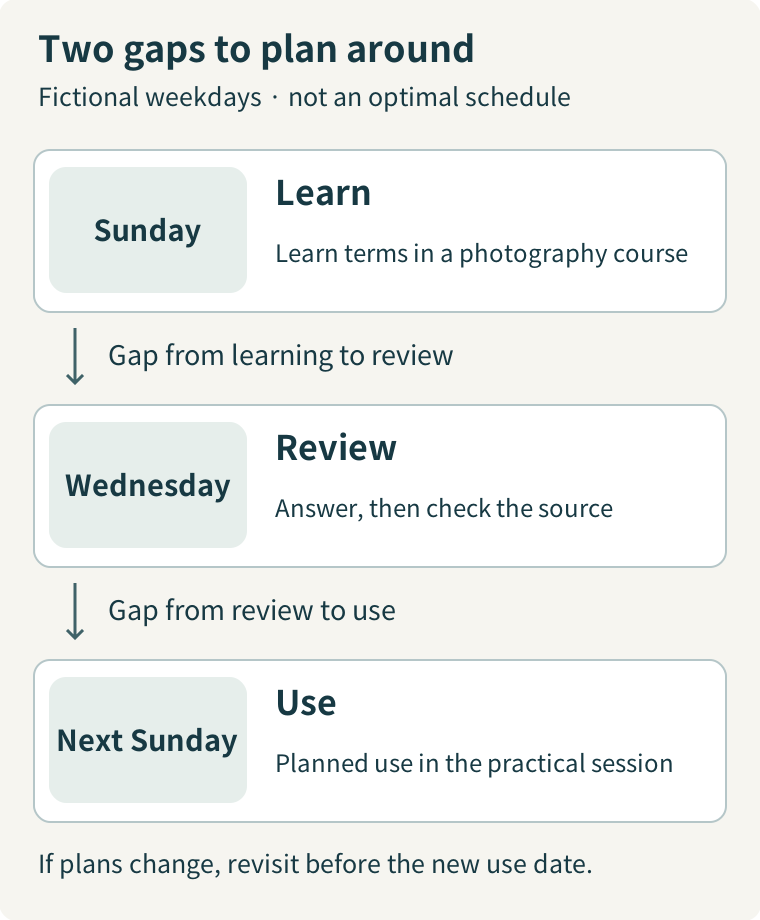
Imagine a fictional adult learner who studies ten terms in a weekend course on photography. On Sunday evening, the definitions feel familiar. They could spend the remaining study time repeating the list immediately. Another option is to reserve some of that review for Wednesday, before a practical session the following Sunday.
Wednesday is an example that fits this person's week. It is not a scientifically prescribed three-day interval. The useful decision is to make room for another encounter, rather than assume that finishing the list tonight finishes the learning.
Keep two intervals separate
A spacing plan contains at least three events: learning something, returning to it, and using or being tested on it. There are two different gaps between those events.
- The study gap runs from the first learning session to the review.
- The later retention interval runs from that review to the final test or intended use.
In the fictional week, Sunday to Wednesday is the first gap. Wednesday to the following Sunday is the second. Saying only “I need it in a week” leaves the review date undecided.
Real life is less tidy than a study. You might encounter a term at work between planned reviews, or need it earlier than expected. The two-gap distinction is a way to ask a clearer question, not a demand to keep your calendar free of other learning.
Expand the diagram
Scroll within the diagram horizontally; arrow keys work when focused.
Illustration: two intervals, three events. The weekday example is a planning aid, not a tested schedule.
What one long-term experiment found
Cepeda and colleagues' 2008 online experiment analyzed 1,354 adults who completed its required sessions. They learned 32 facts, reviewed them after different gaps, and took final tests 7, 35, 70, or 350 days after review. The review included answering questions and seeing the correct answers. Primary spacing study
The favorable gap depended on how much later the final test occurred. Increasing a gap helped up to a point, then performance declined; simply waiting longer was not always better. Longer conditions also had more noncompletion, and the reported analysis used completers. These were factual-memory tasks, not a trial of every skill or a personalized calendar. Study methods and results
That supports considering the intended use date when planning. It does not produce an exact date for your next review. Your material, initial understanding and encounters outside the plan are not the same as the experiment's.
Make a small appointment with the material
For the photography learner, a useful calendar entry could be: “Wednesday: explain aperture using what I learned from the course, without opening the notes; then check.” It identifies both the material and what to do. “Study more” leaves both decisions for a busy evening.
You can make an equivalent entry with a word, a definition or a short explanation from your own course. Choose something whose original explanation you can find again. Keep the source page or section with the reminder so the review does not become a search through old files.
At the return visit, try answering the question before opening the answer. Then check and correct it. If the material was never clear, read its explanation again. A gap in time cannot supply an explanation that was missing at the start.
The small appointment is an editorial suggestion. Neither one item nor Wednesday was tested as an optimal amount or date. It is a manageable place to start observing what happens when you revisit something after a break.
Let the next use constrain the plan
If the practical session moves to Tuesday, a Wednesday review no longer helps prepare for that session. Move the return visit before the new use date. Do not preserve an attractive spacing pattern at the expense of the reason for learning.
If you want to keep the material available for months, today's plan can be the first return visit rather than the whole schedule. After that visit, decide what needs another encounter. You need not construct a year's sequence before learning whether the first item is understood.
Likewise, forgetting at review does not establish that your gap was “wrong.” It could reflect an unclear cue, incomplete initial learning, or material you confused with something else. Use the source to identify what needs work before changing every date.
You do not need a magic sequence
A 2011 experiment by Karpicke and Bauernschmidt involved 96 undergraduates learning Swahili–English pairs. With a final test one week later, increasing total spacing helped, but expanding, equal and contracting schedules did not differ detectably when total spacing was matched. Its gaps were intervening trials within practice, not days on a calendar. Primary retrieval-schedule study
This does not establish that every schedule is equivalent. It does give a reason to be cautious about presenting one increasing sequence as the universally best recipe.
For now, choose one learned item, note when you next expect to use it, and set one feasible review on another day before then. When you return, check the answer and your understanding. That is enough to turn “I'll look at it again sometime” into a specific next step.
Sources checked October 11, 2026. This is a research-based explanation with fictional examples and an editorial planning suggestion. No learner study, retention measurement or efficacy test of this routine was run.