You got it right. Should you still review it?
Keep one correct answer you were unsure about in your review pile. Before checking the answer key, mark the question if you hesitated. After checking, use that mark to find a correct response that still deserves a closer look.
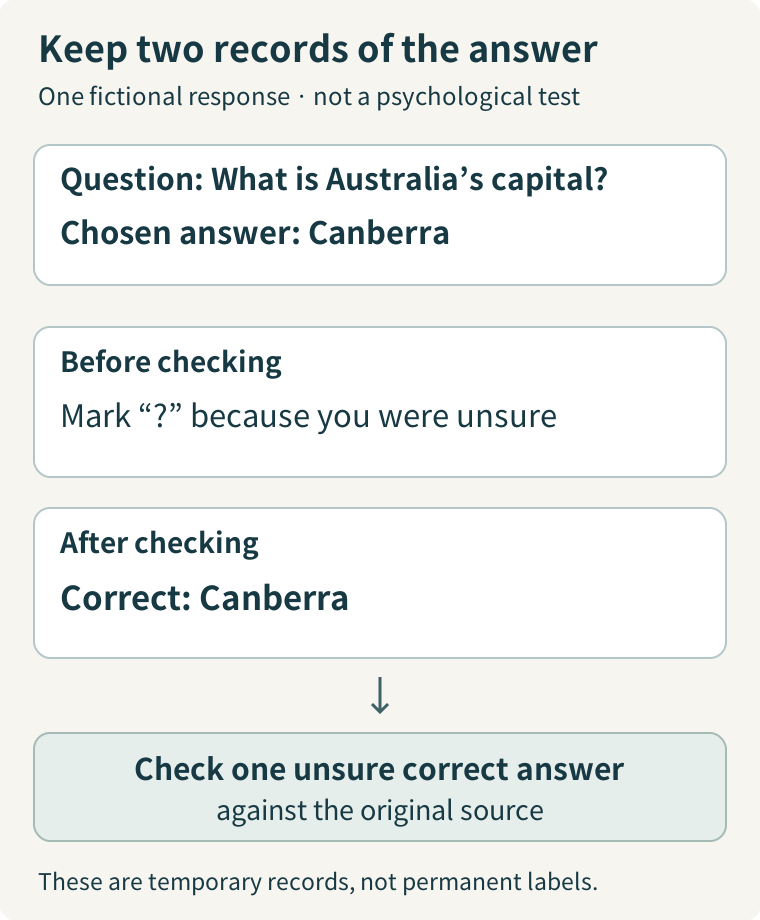
Imagine a fictional adult working through a general-knowledge quiz. Asked for Australia's capital, they hesitate between Sydney and Canberra, then choose Canberra. The answer is correct: the country's National Capital Authority identifies Canberra as the national capital. Yet the learner was not sure when choosing it. National Capital Authority
If their review routine keeps only wrong answers, this question disappears. That may discard a useful opportunity to confirm something they already partly knew. A correct score and certainty about that particular response are two different pieces of information.
Record the hesitation before seeing the answer
A simple “?” beside the response is enough for this exercise. It means “I was unsure about this answer,” not “I am a poor learner.” Confidence here concerns one response at one moment. It is not a judgment about personality or general ability.
Make the mark before looking at the key. Once “Canberra” is visible, you are no longer recording the same moment of uncertainty. You do not need to reconstruct an earlier feeling from memory or invent a precise confidence percentage.
After checking, leave the correctness result and the hesitation mark separate. “Correct, but unsure” is a usable description. So is “Incorrect, although I felt sure.” The latter still needs correction; the former should not automatically vanish from view.
Expand the diagram
Scroll within the diagram horizontally; arrow keys work when focused.
Illustration: keep the answer result and the earlier hesitation visible. This is a record of one fictional response, not a psychological test.
Feedback can help after a correct response
Butler and colleagues' 2008 experiments each involved 30 undergraduates answering four-choice general-knowledge questions and rating confidence before feedback. Half the tested questions received the correct answer; the others received no feedback. Final tests required recalling answers without alternatives. Experiment 1 used a five-minute filler; Experiment 2 tested two days later. Primary feedback study
Correct-answer feedback helped retain initially correct, low-confidence responses, as well as correct errors. The second experiment also found more accurate confidence judgments at the final test. These limited tasks do not establish the best allocation of your review time or prove that all unsure correct responses were random guesses. Study results and discussion
The practical implication is modest: a correct response can still provide an occasion for learning from feedback. The experiment did not test the exact mark-and-review routine proposed here.
Check one answer you nearly discarded
In the capital example, the learner can check that the question asks for the national capital, confirm Canberra in the original source, and note the distinction that caused the hesitation. Their note could simply read: “Australia's national capital: Canberra. I hesitated between Canberra and Sydney.”
There is no need to invent a confident explanation of how they selected the answer. Perhaps they remembered something, eliminated alternatives, or guessed. If they do not know which happened, they can leave that uncertain too. The useful next step is confirming what the source supports.
For a course question with a worked solution, go beyond matching the final answer if the task requires a method. Check the condition or step you were unsure of. If your reasoning differs from the solution, find out whether it is another valid route or an error that happened to end at the same answer. A matching result alone does not settle that comparison.
Use the course's reliable answer and explanation. If you copied a key into your notes, return to the original when something looks inconsistent. Repeating a copying mistake would not resolve the uncertainty. If the question itself has two plausible readings, record the ambiguity instead of forcing it into a clean right-or-wrong label.
Do not turn the mark into a new score
The mark is a reminder of where to look, not a target to minimize. Leaving every question unmarked would make the page tidier without showing that you understood more. Marking everything as unsure would also make it less useful for choosing a specific response to revisit.
Use an ordinary description that fits the moment: “sure,” “unsure,” or simply a mark for hesitation. You do not need to diagnose a learning style or calculate a personal confidence index. The research used formal ratings, but this small exercise does not reproduce or validate that measurement system.
Checking the source can settle whether this answer is supported. It cannot certify that you will remember it next month. If the material matters later, a later attempt can tell you something different: whether you can produce the answer then.
Keep the rest of your review in view
Wrong answers still need attention, including ones given confidently. A correct answer given confidently may also need later review. Today's outcome is not a permanent label attached to the item.
Nor does this article prescribe reviewing every hesitation before any error, or splitting study time into a particular ratio. The study did not compare those planning rules. Use your course requirements, remaining confusion and next use of the material to decide what else belongs in the session.
For the next quiz, make one change: mark hesitation before checking, then select one marked answer that turned out to be correct and confirm it against the source. Let the correct result stand, while giving its uncertainty a little attention.
Sources checked October 11, 2026. Examples are fictional and the suggested routine is an editorial adaptation of primary research. No learner study, retention measurement or efficacy test of this routine was run.