Why do some autumn leaves turn red and others yellow?
Two trees can stand beside the same path and change to quite different colours. Yellow often appears as green chlorophyll declines; red in many autumn leaves involves newly made anthocyanin pigments. The useful thing to watch is the combination of pigments, tree identity and conditions, rather than temperature alone.
Green leaves already contain more than green
A summer-green leaf is not a blank sheet waiting to be coloured in autumn. Its chlorophyll helps capture light for photosynthesis, and other pigments are present too. Among them are carotenoids, which contribute yellow and orange colours.
During the seasonal ageing of many deciduous leaves, chlorophyll breaks down and is not replaced at the same rate. As its green contribution diminishes, carotenoids become easier to see. The yellow has not necessarily just been manufactured. The Forestry and Forest Products Research Institute in Japan explains this distinction between the loss of green and the visibility of existing yellow pigments. The institute’s explanation of leaf colour
This also makes “the leaf’s true colour was hiding underneath” an imperfect description. Green was a real part of the leaf’s colour too. What changes is the contribution of different pigments, rather than a painted cover peeling off.
Red often requires something being made
In many trees that redden in autumn, anthocyanins accumulate as the leaf ages. These red-to-purple pigments can be synthesised while chlorophyll is declining. A Japanese maple and a yellowing ginkgo are familiar examples of different autumn colour pathways, discussed by the University of Tokyo. Why maple trees turn red
So the simple account “all autumn colours were there throughout summer” misses an important part of the story. But the reverse claim, that anthocyanins exist only in autumn, would also be wrong. Some plants have red young leaves or other red tissues. This article concerns the seasonal change of previously green leaves, not every red plant or every pigment that can look red.
Compare two simplified colour changes
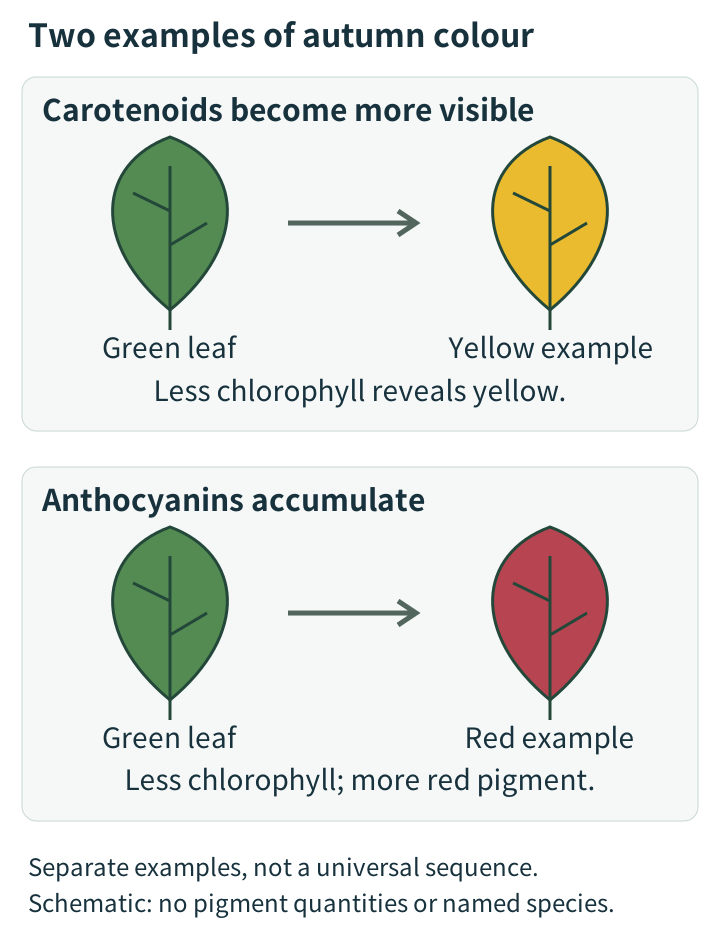
The diagram separates two useful examples. It is not a sequence every leaf must follow, a measurement of pigment quantities, or a photograph of a particular species. Real leaves can contain several pigments at once, and their colours may be mixed or patchy. Kew’s account emphasises that the mixture varies among species. Kew on autumn pigments
A cold night is one part of the explanation
Day length, light, temperature and the tree’s water conditions all contribute to the seasonal process. Sunny days and cool nights can favour red pigmentation in some circumstances, but “colder means redder” is not a dependable rule for every tree. The University of Minnesota’s account describes both weather influences and variation in how plants respond to stress. How conditions affect autumn colour
One experiment makes the connection more specific. Researchers cooled selected branches on a single mature sugar maple and compared them with control branches. The cooled branches had higher concentrations of sugars and anthocyanins in their leaves. The work supports a link between branch cooling, sugar accumulation and red pigment formation under those experimental conditions. The original branch-cooling study
Notice the scale of that evidence: selected branches on one tree, with chemical measurements. It does not establish a universal temperature threshold, predict the colour of your street, or show that every red species follows precisely the same route. There is no reason to chill, wound or otherwise stress a tree for this observation.
Compare one thing at a time
On your next ordinary walk, choose one accessible tree that you can recognise again. Stay on the path and leave its leaves attached. You do not need a famous viewpoint or a collection of specimens.
Start with a small question: does the outer part of the crown look the same as the sheltered interior? Then look at two leaves on an accessible branch. Are they evenly coloured, or does one still have green areas? Keep the description separate from the explanation: “the outer leaves look redder today” is an observation; “extra sunlight caused it” is a hypothesis.
A short record might include:
- The date and a description of the tree’s location
- Its name, if known, or “identity uncertain”
- Which branch or part of the crown you compared
- Colours and patches you could actually distinguish
- Whether the view was sunny, shaded or backlit
These are observation prompts, not results from a field visit made for this article. If you use a phone, return to a similar viewpoint and lighting where practical. Camera adjustments and changing illumination can make two pictures look more different than the leaves did to your eyes. A simple written note can preserve what you were trying to compare.
Next, consider a neighbouring tree. If it belongs to another species, you have changed more than one variable: tree identity as well as position. That comparison can still be interesting, but it cannot isolate the effect of one night’s weather. Repeated looks at the same tree answer a different question from a row of photographs of different trees.
Colour explains a process, not everything about the tree
The green-to-yellow and green-to-red examples help you ask better questions, but colour alone cannot diagnose the tree’s health or reveal its exact pigment concentrations. Nor is a yellow leaf necessarily a red leaf that has not reached the next stage.
The reason for producing red pigments is also a research question. Proposed benefits include protection from excess light and interactions with plant-eating insects; the University of Tokyo presents these as hypotheses with different evidence, rather than one settled purpose for every species. A colourful leaf does not let us choose among them by sight.
Look again at the two trees beside the path. Instead of ranking which has “better” autumn colour, ask what remains green, what becomes visible, and what may be newly produced. A familiar seasonal scene becomes a record of several processes working together.
Sources and verification
Sources were checked on October 11, 2026 UTC. This is a region-neutral explanation, not a current foliage report or forecast. The illustration and observation prompts are original; no field survey, pigment test or tree-cooling experiment was performed for this article.