8x or 10x binoculars for concerts? How to choose before you know your seat
If your seat is still a mystery and this is your first pair, start with 8x for easier handheld viewing and following the action. Put 10x on your shortlist if seeing one performer larger matters most and you can hold the image comfortably steady. Wear glasses? Check the fit at your eyes before choosing either magnification.
An arena or stadium name alone cannot tell you the right power. A main stage, runway, or center stage can put the same performer at very different distances. Start with what you want to watch.
Choose the viewing experience first
- Following movement and switching between the stage and binoculars: try 8x first. How quickly can you find the performer again?
- Getting a larger view of one performer or a costume: compare 10x. A bigger image helps only if shake does not make the detail hard to see.
- Keeping your glasses on: check eye relief and eyecup fit before committing to either power.
This is a shopping starting point. Nikon explains that higher magnification makes hand movement more noticeable and can make moving subjects harder to follow. Nikon’s specification guide
What do you gain with 10x?
The ratio is 10÷8 = 1.25. At 10x, the apparent height and width of a subject are about 25% greater than at 8x. That does not mean a seat “25% closer,” or 25% more recognizable facial detail. Lighting, optical quality, focus, and shake still matter. How Nikon explains magnification
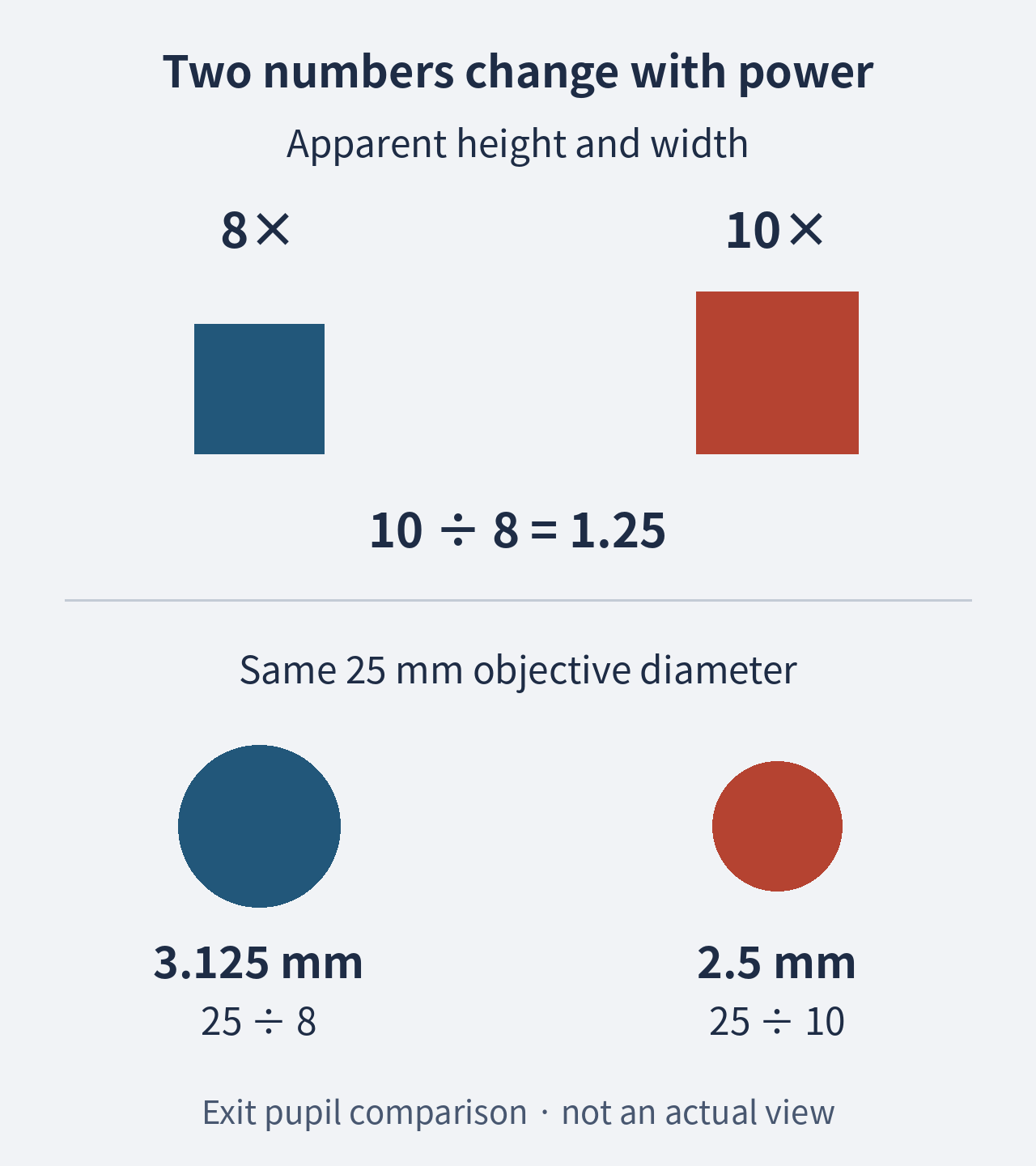
This original diagram shows numerical relationships. It is not a view through binoculars or a simulation of any concert seat.
Also compare real field of view, the angle you can see without moving the binoculars. A wider field gives you more room to locate a performer. Check each model’s specification; magnification alone does not determine field of view. Nikon’s field-of-view explanation
Compare a matched pair, not two unrelated products
For a US-market example, Nikon’s US specification pages list these two TRAILBLAZER II models. Both have 25 mm objective lenses. Use them to compare specifications; check current prices and stock separately.
| Published specification | TRAILBLAZER II 8x25 | TRAILBLAZER II 10x25 |
|---|---|---|
| Real angular field of view | 8.3° | 6.5° |
| View width at 1,000 meters | 145 m | 114 m |
| Exit pupil, listed | 3.1 mm | 2.5 mm |
| Eye relief | 10 mm | 10 mm |
| Listed weight | 10.9 oz. (310 g) | 10.9 oz. (310 g) |
Sources: Nikon USA TRAILBLAZER II 8x25 specifications and 10x25 specifications. Nikon lists field width at a standard distance of 1,000 meters. Scaled to 1,000 yards, those rounded figures give approximately 435 ft. for 8x and 342 ft. for 10x. These are our conversions, not separately published specifications.
In this pair, 8x shows a wider area and both weigh the same. Lower power does not automatically mean lighter binoculars. The short eye relief also makes these a pair to try carefully if you wear glasses.
Check low-light performance and glasses fit separately
Exit pupil describes the width of the light bundle leaving the eyepiece. Divide objective diameter by magnification: 25÷8 = 3.125 mm; 25÷10 = 2.5 mm. A larger exit pupil can help in low light, but the difference also depends on your own pupil size and the lighting. Nikon’s exit-pupil guide
Lens and prism coatings also affect how much light reaches your eyes. You cannot turn those two diameters into a guaranteed percentage difference in perceived brightness. A dark audience area can still face a brightly lit performer. Why brightness figures have limits
For glasses, eye relief is the distance between the eyepiece lens and the viewing position of your eye. Nikon identifies 15 mm or more as a useful glasses-friendly specification. Treat it as a starting point: frames, eyecups, and face shape affect fit. The examples above have only 10 mm. Adjust the eyecups as instructed and check that you can see the whole field without pressing against your glasses. Nikon’s eye-relief guide
Image stabilization is a separate choice
If you like the size of the 10x image but find the shake distracting, try an image-stabilized pair. Compare the price, battery requirements, and weight too. For example, Nikon’s STABILIZED 10x25 S weighs 14.3 oz. without batteries, versus 10.9 oz. for the compact examples above. Nikon USA stabilized specifications
Try stabilization both on and off. It reduces image movement caused by your hands; it cannot stop a performer moving across the stage. The benefit has to be worth the cost and carrying weight to you.
A five-minute test before you buy
Try this at a store or with a rental. It will not reproduce concert lighting or distance, but it can reveal awkward fit and handling.
- Minute 1: adjust the fit. Wear the glasses you’ll use at the show. Set the barrel spacing, eyecups, and focus as the instructions describe. Check for one clear, uncropped view.
- Minute 2: try 8x. Use a distant sign or patterned object. Keep your elbows gently tucked in and see how comfortably you can read the small details.
- Minute 3: try 10x on the same target. Notice both the larger image and any extra distracting movement.
- Minute 4: lower and raise each pair. Find the target again, then switch to another one off to the side. Which pair makes this easier?
- Minute 5: choose comfort or detail. Prefer 10x if the larger view helps and feels steady enough. Choose 8x if finding and holding the view is noticeably easier. If neither fits, try another model.
You can settle those questions before your seat assignment arrives. Before buying or renting, check the official rules for your particular event and venue, too.
Sources checked October 8, 2026 (UTC). This guide uses manufacturer specifications, not independent product testing. Live inventory and selling prices have not been verified.