Why does washing-up liquid help water remove grease?
Picture the oily film left on a plate after a meal: a splash of water may leave much of it behind. Surfactants help water wet the surface and carry oily material away, with washing action and rinsing. The grease has moved into the wash water; it has not simply disappeared, and the amount of foam does not tell you how much was removed.
Start with the oil, not the bubbles
Water dissolves some familiar kitchen materials, such as sugar, readily. Cooking oil behaves differently: it does not readily form a uniform molecular solution in plain water. That makes an oily film a different cleaning problem from a little spilled sugar. The American Chemical Society introduces this distinction in its educational sheet, A Matter of Mixing. Water, oil and materials that dissolve
“Oil and water do not mix” is useful shorthand, but it needs care. Oil can be broken into droplets and distributed through water. That distribution is not the same thing as oil becoming water-soluble like sugar. The question at the sink is whether oily material can be detached, kept in the washing liquid long enough, and removed from the plate.
An ACS classroom activity contrasts oil and water with and without detergent. Its stated point is that detergent helps oil mix with water so it can be washed away. We have not performed that activity; the diagrams here explain a mechanism rather than report its results. The ACS oil-and-water activity
One molecule can interact with two surroundings
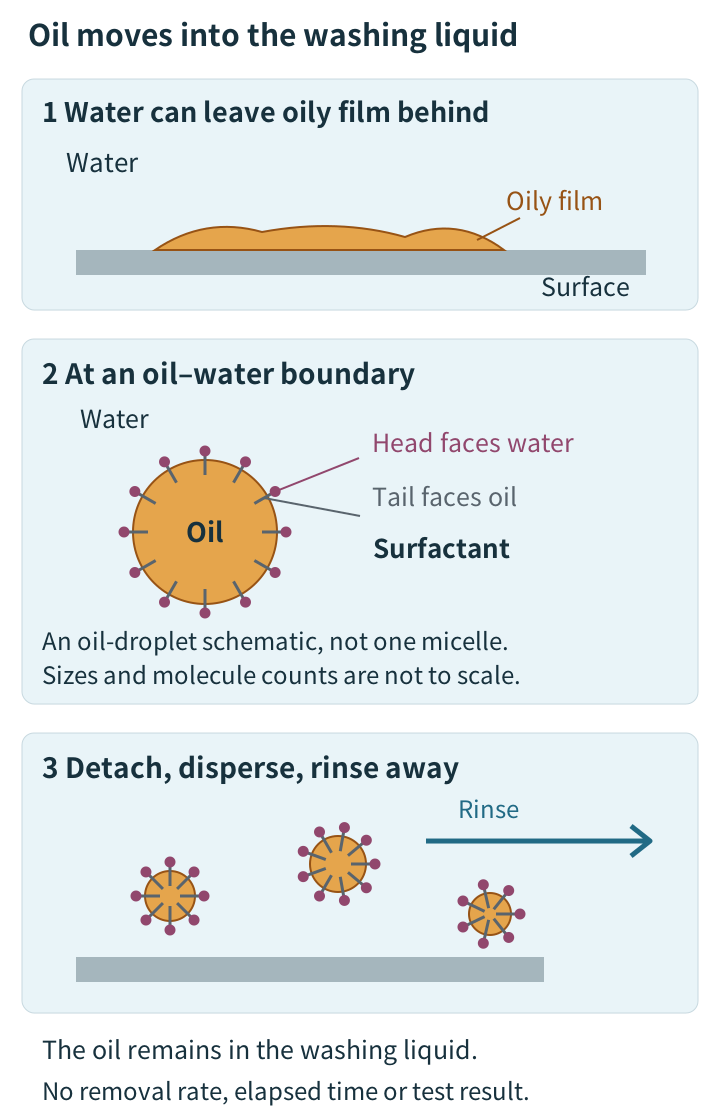
A typical cleaning surfactant has a water-friendly, or hydrophilic, part and an oil-friendly, hydrophobic part. The familiar “head and tail” drawing is a shorthand for these regions, not a literal creature gripping dirt. At an oil–water boundary, the water-facing region can stay in contact with water while the oil-facing region extends into the oil.
That arrangement helps lower the interfacial tension between oil and water. Surfactants acting as emulsifiers can also help keep dispersed oil droplets from merging back together. AOCS, a scientific society focused on oils and related materials, describes this boundary arrangement. How an emulsifier surrounds an oil droplet
There is another helpful effect: surfactants lower water's surface tension and can improve its wetting of materials. Wetting is about the washing liquid making contact with a surface. It is related to cleaning, but “lower surface tension” alone is not a complete account of every stage. Michigan State's explanation of surfactants and wetting
Expand the diagram
Scroll within the diagram horizontally; arrow keys work when focused.
In the original illustration, orange represents oily material, pale blue represents water, and the small head-and-tail marks represent surfactants. The middle panel enlarges the oil–water boundary. Neither the droplet sizes nor the number of molecules is to scale. The bottom panel follows the oil into wash water rather than making it vanish.
Detaching is only part of the job
Think through the plate example as a sequence of jobs: bring washing liquid into contact with the oily area, help release oily material, then take the dirty liquid away. Movement during washing helps work on the film; rinsing provides a route off the plate. This is an explanation of those roles, not a promised number of wipes or a measured cleaning time.
Dispersion matters because detached oily material can still be present in the water beside the surface. AOCS explains how emulsifiers help droplets resist coalescence, the joining of small droplets into larger ones. Calling an emulsion “mixed” does not mean the oil has been chemically destroyed, or that the mixture must remain unchanged indefinitely.
There is also a smaller-scale process. At suitable concentrations, surfactant molecules can assemble into clusters called micelles, with their water-avoiding regions inside. Those clusters can accommodate oily substances. Michigan State describes their reversible assembly and their role in carrying otherwise water-insoluble material. An emulsified oil droplet and a micelle are related ideas, but they are not interchangeable names for every round shape in a cleaning diagram.
Our middle drawing is specifically an oil droplet with surfactant at its boundary. It does not claim to show an individual micelle, an actual microscope view, or every mechanism operating in a formulated detergent.
Foam answers a different question
Foam contains gas bubbles separated by liquid films. Surfactants can help those films persist. Washington State University's explanation of soap bubbles describes how soap helps water spread into a thin film around air. The same general kind of molecule can therefore participate in bubble formation as well as oily-soil removal. Why soap makes bubbles
That does not make foam height a calibrated grease meter. Two questions remain separate: “How much air has been held in films?” and “How much oil has left this surface?” Seeing a frothy sink gives no numerical answer to the second. A change in bubbles is an observation; assigning a percentage of cleanliness to it would need a defined test.
For the same reason, a less visible film is not a measurement of every residue, and this article does not establish disinfection or food-safety performance. It explains one ordinary cleaning mechanism.
Read the product as a formulation
People often call washing-up liquid “dish soap,” but soap and detergent are not identical chemical categories. Soap is a particular kind of cleaning surfactant; formulated detergents can use other surfactants and additional ingredients. ACS explicitly distinguishes the terms. Soap and detergent terminology
Understanding that distinction is more useful here than ranking brands. Use a product for its labelled purpose, amount and rinsing instructions, and follow the item's care directions. This explanation is not a recipe for homemade detergent or for combining cleaning products. Do not mix cleaners to explore the mechanism.
The useful change in your mental picture is small: stop imagining foam swallowing grease. Imagine oily material meeting a washing liquid that can interact with both oil and water, then leaving with that liquid. The bubbles are visible company; the transfer of oily material is the cleaning question.
Sources and verification
Sources checked October 11, 2026 UTC. Diagrams are original schematics. No kitchen experiment, product comparison, grease-removal measurement, microscopy or real-world cleaning trial was performed.