Will your existing pan work on induction? Check more than the magnet
A magnet sticking to the bottom helps identify a candidate. The pan still needs the right base size, shape, condition, and approval for your particular cooktop. A positive magnet check does not establish that every burner or special cooking mode will work properly.
- Suitable material, base dimensions, shape, and condition: consider keeping the pan.
- Magnetic but too small, warped, or poorly documented: check the specifications before heating.
- Outside the appliance's requirements or visibly damaged: choose a suitable replacement instead of improvising.
If you are moving to an induction kitchen, this can save an unnecessary cookware-set purchase. Start with the saucepan or skillet you use most. Keeping a suitable favorite saves money and cabinet space; learning its placement, heat settings, and care requirements still takes attention.
Check the cold base, away from the cooktop
With the appliance off and the pan cool and dry, use a small household magnet on the bottom of the pan in a stable work area. Put the magnet away afterward. Do not leave it in the pan or on the cooking surface, and do not handle a hot pan to investigate its base.
Frigidaire's cookware guidance describes this as a way to check the base material. That is the useful scope: a material check.
The side of a stainless-steel pan may behave differently from its base. Some cookware combines layers or has a magnetic disk bonded to an otherwise different body. Check the actual bottom and consult the pan maker's induction information. “Stainless steel” alone is not a complete compatibility description.
Do not turn how strongly the magnet seems to stick into a heating-performance score. This simple check cannot tell you how evenly food will cook, whether a burner will recognize the pan, or whether a special temperature-control mode supports it.
Measure the part that matters
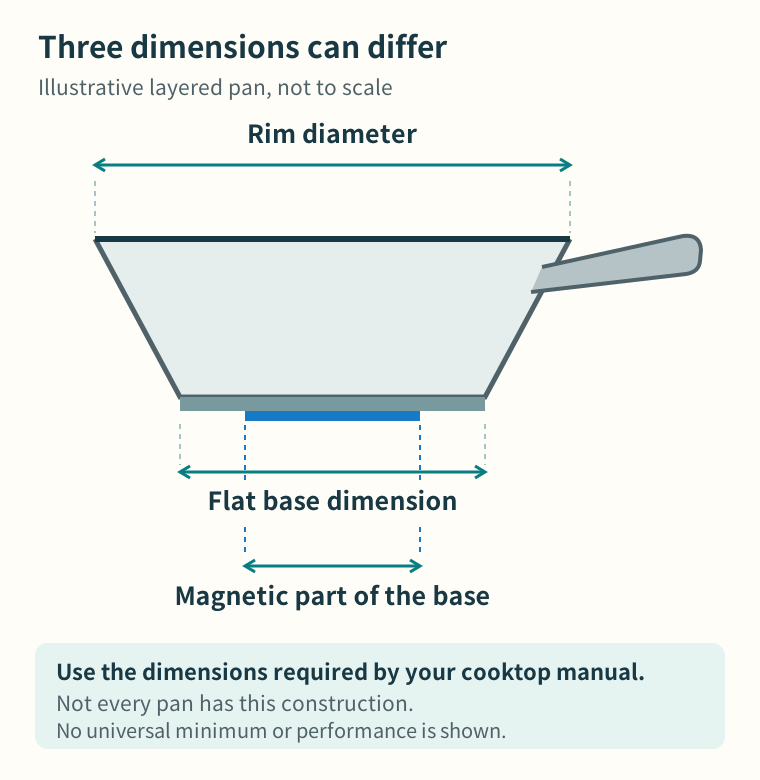
A skillet advertised as 10 or 12 inches may be described by its rim diameter. The flat bottom can be smaller, and its magnetic portion may be smaller again.
GE Appliances' size guidance tells owners to measure the flat, magnetic area of the bottom and consult their model's manual for minimum size. A small magnetic disk can leave a seemingly large pan unsuitable for a particular element.
Expand the diagram
Scroll within the diagram horizontally; arrow keys work when focused.
Figure: Three dimensions can differ. This is an illustrative layered pan, not the construction of every pan.
Use the size requirements for the actual element you plan to use, then center the pan as instructed. Do not assume a larger pan is always an improvement. Check clearance from controls, trim, and neighboring cookware, plus any rules for bridge or flexible cooking zones. Matching a pan's rim to the printed burner circle is not enough.
If the manufacturer lists both overall diameter and cooking-surface diameter, keep those labels with the measurements. A photograph of the base and model marking can help support identify an uncertain pan.
Look for damage and instability
Inspect the cool pan on a suitable flat surface. A rounded bottom, feet, noticeable rocking, or distortion calls for a closer check against the manual. Do not hold an unstable pan down while it heats or try to hammer its base flat.
A separating bonded base is a reason to stop using the pan and contact its maker. Panasonic's cookware guidance specifically warns that a peeling base can overheat abnormally and damage the cooktop. This is a material-condition warning, not permission to use a Japanese appliance's size limits on a US model.
Clean residue using the cookware and appliance care instructions. Do not grind away part of the bottom, remove layers, or attach a metal plate to make an unsuitable pan appear compatible. Move heavy cookware carefully rather than dragging it across the glass.
Check the appliance manual, even when the box says induction
A cookware label is useful evidence, but it does not replace the cooktop's requirements. Bosch's induction-cookware explanation gives the familiar magnetic-base test. Read that together with the actual appliance manual's size and placement instructions, not as a universal approval.
Look up the exact US model you own, not a similar-looking model sold elsewhere. Features and supported cookware can differ. Approval for a different appliance or cooking zone does not establish support on the one in front of you.
Special functions may add another layer of requirements. If you intend to use a temperature-controlled frying mode, an assisted-cooking program, or a particular probe accessory, read that feature's cookware conditions separately. Being recognized in ordinary manual heating does not prove compatibility with every mode.
Do not use an empty-pan heat test as the shortcut
You can complete the material, dimension, and condition checks without turning the cooktop on. Do not put an unknown empty pan on maximum power to see whether it heats.
If the appliance manual supplies a cookware-detection or test procedure, follow that procedure only after the pan meets the stated requirements. Do not import water quantities, power settings, or indicator meanings from another model's instructions. If there is no clear procedure, ask the appliance or cookware manufacturer.
A pan that is not detected should lead you back to size, centering, material, and the model's troubleshooting instructions. Do not bypass pan detection or try an unapproved adapter. Stop for unusual smells, visible damage, or an unresolved error rather than repeatedly increasing power.
Keep one useful record, then decide what to buy
For your most-used pan, note its model, bottom material, magnet response, measured base dimensions, condition, and intended element. Keep the relevant manual section with that note.
If it meets the requirements, begin with normal cooking according to the instructions. If it does not, replace the one pan you need first. A full matching set is optional. Before buying, check the new pan's base dimensions and care instructions as carefully as its advertised rim size.
Sources checked October 11, 2026. No physical pan, magnet, detection, or heating tests were performed. Recheck the cookware and regional cooktop manuals, including mode-specific conditions, before purchase or use.