Choosing among VYM, SCHD, HDV and SPYD starts with your spending plan
The Useful Question | Reviewed October 12, 2026 | U.S. edition
A dividend ETF can make cash flow easier to manage. Whether that helps depends on what happens next: will you spend the distributions, or reinvest every dollar for another 20 years? That question is more useful than asking which ticker currently has the highest yield.
VYM, SCHD, HDV and SPYD offer different approaches to U.S. dividend-paying stocks. Their selection rules determine what you own and which risks you take. None supplies a guaranteed paycheck.
Separate the investment strategy from the payout
All four funds track indexes. The meaningful comparison is broad-market exposure versus a dividend-focused selection strategy. Indexing describes how a portfolio is managed; its distribution policy describes how cash reaches shareholders.
A broad-market fund can own companies with little or no dividend alongside established dividend payers. Dividend strategies deliberately narrow that universe. They can therefore have different sector exposures and miss gains in excluded companies. Broad capitalization-weighted funds can also become concentrated in the largest businesses. Neither the word “index” nor a large holding count settles the diversification question. Vanguard explicitly identifies the possibility that dividend-focused stocks will underperform other investments in VYM’s prospectus.
Compare the rules before the yield
Annual expenses below are issuer figures checked October 12, 2026. They exclude your taxes, bid-ask spreads and any brokerage charges. Target index counts may differ from actual ETF holdings.
| ETF | Underlying approach | Annual expense ratio |
|---|---|---|
| VYM | FTSE High Dividend Yield; higher-forecast-yield U.S. stocks; float-adjusted market-cap weighting | 0.04% |
| SCHD | Dow Jones U.S. Dividend 100; dividend history and financial metrics; capped market-cap weighting | 0.06% |
| HDV | Morningstar Dividend Yield Focus; quality screens; target 75 stocks, dividend-dollar weighting | 0.08% |
| SPYD | S&P 500 High Dividend; 80 higher-yielding members, equal weighted at rebalancing | 0.07% |
VYM uses forecast dividends and excludes REITs during selection. Its public FTSE rules also reference proprietary screens, so a simple yield sort does not fully reproduce the process.
SCHD’s index requires ten consecutive years of dividend payments and evaluates free cash flow relative to debt, return on equity, yield and five-year dividend growth. Ten years of payments does not mean ten consecutive increases. The index methodology supports a quality-oriented dividend screen, not a promise of future growth.
HDV’s index rules use competitive-advantage and financial-health assessments. Weighting by dividend dollars can still produce substantial company and sector concentrations.
SPYD is included because its yield-led, equal-weight approach provides a useful contrast. Equal stock weights do not mean equal sector weights. Its methodology also includes selection buffers and discretion to exclude an unsustainable indicated yield. It should not be described as mechanically buying the highest 80 yields regardless of circumstances.
Income can arrive during a losing year
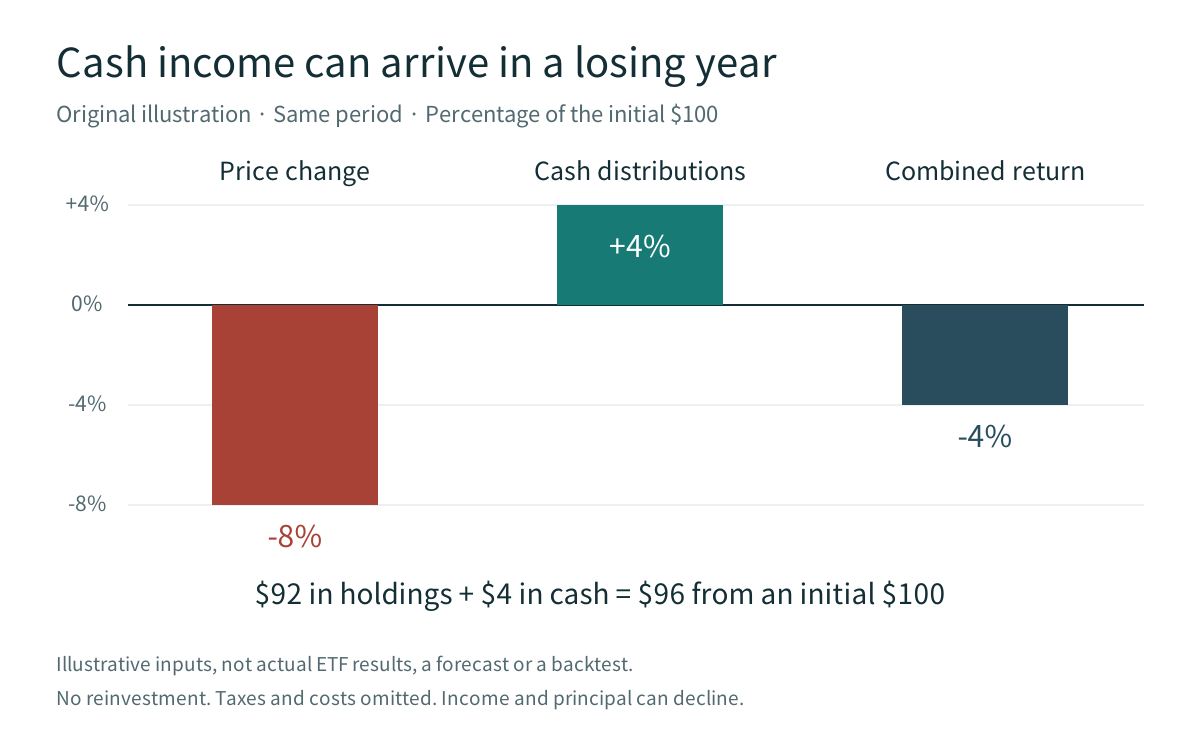
Suppose a $100 investment ends a period worth $92 and has paid $4 in cash. With no reinvestment, taxes or costs, combined ending wealth is $96: a 4% loss despite receiving cash equal to 4% of the initial investment.
Expand the diagram
Scroll within the diagram horizontally; arrow keys work when focused.
Figure: Original arithmetic illustration using the same period and starting investment. This is neither historical performance nor a forecast or backtest.
A distribution reduces the fund’s net assets when paid out. It does not create extra wealth by itself. Companies can also cut dividends. The SEC explains these mechanics in its fund-distributions bulletin.
Compare total returns over matching periods and state whether distributions are reinvested. For income comparisons, use the same yield definition and measurement date. A 30-day SEC yield and a trailing-12-month distribution yield answer different questions; neither locks in next year’s cash flow.
Payout frequency also needs checking. HDV’s current issuer page lists monthly distributions. Older quarterly descriptions should not be recycled. More payment dates do not establish a higher annual payout.
Match cash flow to the account and the spending need
For someone funding current expenses, distributions can reduce the number of sale decisions and make budgeting feel more manageable. But a spending plan still needs room for lower payouts and falling share prices. Choosing a riskier portfolio to meet a fixed dollar target can leave both income and principal exposed.
For someone accumulating wealth, compare after-tax total return, diversification and costs alongside the convenience of receiving dividends. A broad portfolio with planned share sales is another way to generate spending cash. Selling during a downturn presents risks; relying on dividends does not remove the underlying equity risk either.
In a taxable brokerage account, reinvesting a dividend does not by itself eliminate the tax. Qualified-dividend treatment depends on applicable requirements, including holding periods; check your Form 1099-DIV rather than assuming every dollar qualifies. IRS reinvestment guidance, IRS dividend guidance, qualified-dividend requirements
Inside an IRA, an ETF distribution and a withdrawal from the account are separate events. Traditional and Roth IRA rules differ, and a high-dividend holding does not remove withdrawal restrictions or taxes that otherwise apply. IRS IRA guidance
These are U.S.-listed, dollar-traded funds. Investors whose expenses are in another currency also face exchange-rate changes when translating portfolio values and cash receipts. A locally domiciled fund that holds one of these ETFs can have separate costs, distribution arrangements and tax treatment; the U.S. ETF’s figures do not describe that wrapper.
Before choosing, write down when you need cash, how you would handle a payout cut, which sectors overlap your existing holdings, and what reaches you after tax. Then compare the rules and full costs. That produces a more durable decision than a yield leaderboard.
This article is general financial education, not individualized investment or tax advice or a recommendation to buy or sell a security. Investing involves risk, including loss of principal. Past performance and simulations do not guarantee future results. Review current disclosures; final investment decisions and responsibility remain with the investor.