Choosing stock funds from global markets to FANG+
Start with the job the investment should do. A broad global stock fund spreads ownership across countries. An S&P 500 fund deliberately emphasizes large US companies. Nasdaq-100 and FANG+ narrow the selection further. Choosing among them means deciding which concentrations you can live with, rather than picking the highest line on a performance chart.
First separate money needed soon and emergency reserves from money that can remain invested through a serious decline. A long horizon does not guarantee recovery. Your allocation among stocks, bonds, and cash matters before the choice of stock index. SEC asset-allocation guidance
Why broad index funds are common starting points
Broad stock funds make it possible to own many businesses without continually picking individual winners. Investors participate in those businesses' profits and distributions, while the benchmark's rules update the membership. This is a manageable approach to long-term equity exposure, rather than a promise that economic growth automatically produces investment gains.
Choosing a low-cost fund also leaves less of the investment return consumed by expenses. The index specifies a portfolio calculation; the fund determines the charges and how closely it follows that calculation. Index funds are not universally cheap or diversified. Those features must be checked in the actual product. Whether either broad approach fits still depends on the investor’s goal and capacity for losses. SEC index-fund guide
Global exposure leaves less country selection to you
The MSCI ACWI Index covers large and midsize companies in developed and emerging markets, including the US. It weights eligible shares by free-float-adjusted market capitalization. Countries do not receive equal allocations, and small companies are outside this index's scope. Regular reviews take place in February, May, August, and November, alongside event-driven changes. MSCI overview, methodology
A US investor can seek global exposure through a global fund or combine US and international funds, checking whether the international portion includes emerging markets. Combining funds means choosing and maintaining the split yourself. Different global benchmarks also vary in small-cap coverage: MSCI ACWI IMI, for example, adds small caps. MSCI ACWI IMI
This approach can suit someone who wants broad geographic participation without selecting the next leading country. It still exposes them to large companies and markets carrying substantial weight, including the US. It can lag a single-country portfolio for long periods.
The S&P 500 makes a deliberate US choice
The S&P 500 covers 500 large US companies across sectors. Free-float-adjusted market capitalization determines weights. Eligibility criteria and an index committee shape membership, so it is not simply the 500 largest stocks. Share data receive quarterly updates; constituent changes happen as needed rather than through a fixed annual reshuffle. S&P overview, methodology
It can be a candidate for someone who deliberately wants US large-cap exposure and accepts missing markets that may outperform it. Overseas sales by US companies do not make the portfolio equivalent to owning non-US stock markets. US small companies are also outside its broad target.
Nasdaq 100 and FANG+ add narrower selection rules
Nasdaq-100 targets 100 large nonfinancial companies listed on Nasdaq, including eligible international companies. Fast entries can temporarily take membership above 100. It is neither the Nasdaq Composite nor a pure technology index. However, its September 30, 2026 factsheet shows a technology-heavy mix. Its modified market-cap weighting adjusts low-float and large-company concentrations. Quarterly rebalancing and annual December reconstitution remain, with quarterly membership reviews and a large-IPO fast-entry route added in May 2026. Nasdaq methodology, 2026 changes
NYSE FANG+® selects ten US companies from specified technology, media and communications, and consumer-related businesses. Eligible exchanges include Nasdaq as well as NYSE. Selection combines six designated eligible companies with four ranked candidates, rather than simply taking the ten largest stocks. Quarterly rebalancing sets equal target weights; prices move actual weights away from those targets. Equal weighting does not remove concentration in ten companies affected by related business conditions. ICE methodology
ICE's page displayed Meta, Apple, Amazon, Netflix, Microsoft, Alphabet, Micron, NVIDIA, Palantir, and Broadcom when checked on October 12, 2026 UTC. It did not label a composition as-of date, so this is a record of the displayed list, not a dated holdings report. The acronym is no substitute for checking membership. ICE constituent display
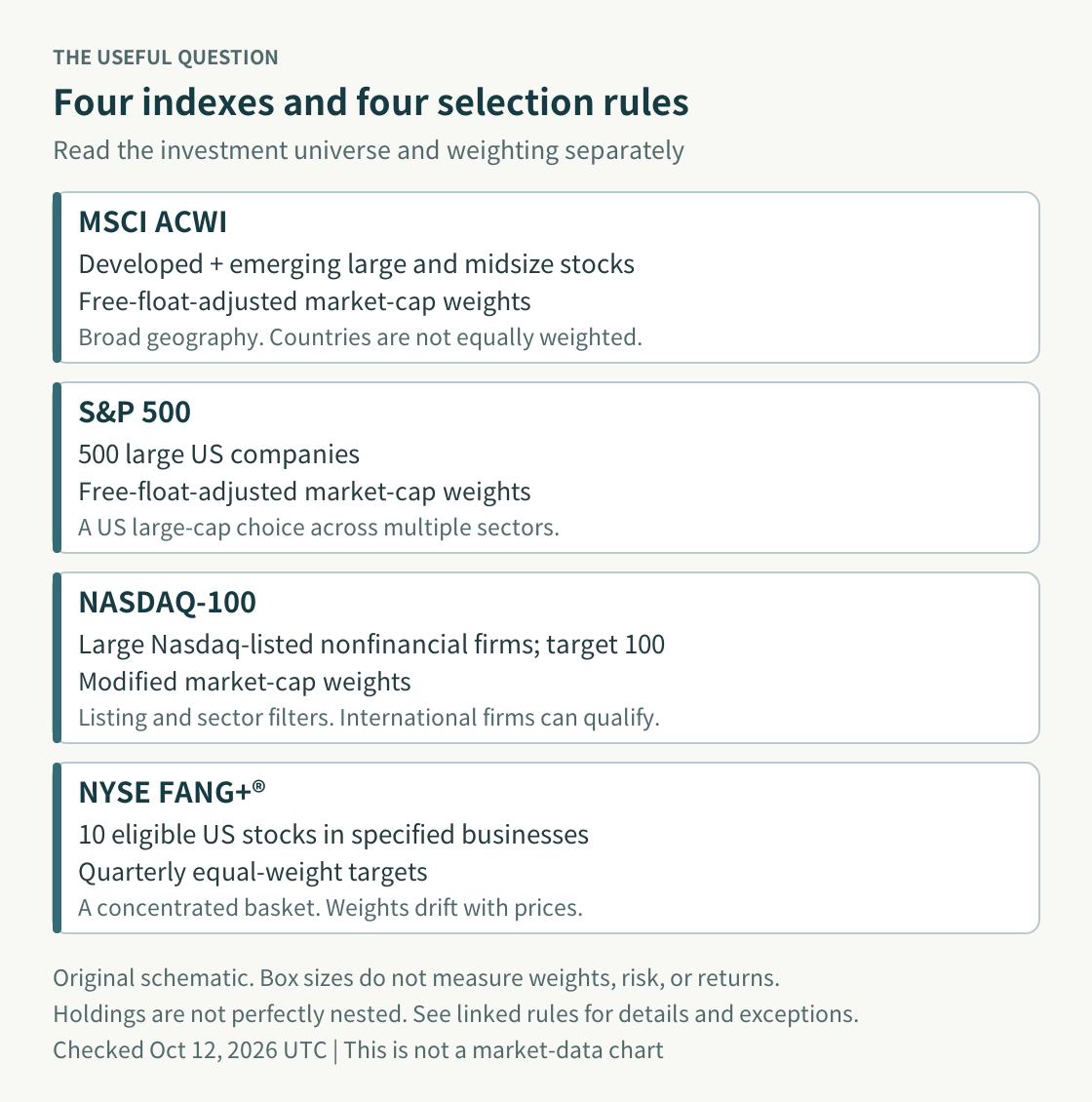
Expand the diagram
Scroll within the diagram horizontally; arrow keys work when focused.
This original diagram summarizes selection rules. It does not depict perfectly nested holdings, measured market weights, or a safety ranking.
Choose a role before choosing a ticker
- For broad geographic participation, investigate a global approach.
- For an intentional US large-cap emphasis, investigate an S&P 500 approach.
- For a technology-heavy tilt spread across roughly 100 companies, investigate Nasdaq-100’s modified-cap approach.
- For an intentionally concentrated ten-stock selection with equal target weights, investigate FANG+.
A concentrated add-on is optional. Set its limit within the whole portfolio before buying. Many of its large companies already appear in broad indexes, so adding it can increase existing company and sector exposures. Review combined holdings, rather than counting fund names. Decide how you would respond if the add-on underperformed for years and when you would review its allocation.
Strong historical Nasdaq-100 or FANG+ returns do not establish future superiority. A fast-growing business can deliver disappointing shareholder returns when its purchase price already assumes exceptional success. A narrower portfolio can also move sharply when expectations change.
Then compare the investment vehicles
Read the current prospectus and supplements for expenses, implementation, and risks. For ETFs, trading spreads and premiums or discounts to net asset value are separate from the annual expense ratio. SEC ETF bulletin
A dollar trading price does not eliminate foreign-currency exposure in an international portfolio. SEC international-investing guide
Match dates, currency, dividend reinvestment, expenses, and tax treatment before comparing performance. This article has not assembled comparable return series and does not present a historical winner chart. Write down a reason for the allocation that could survive a disappointing period. That is more useful than assuming yesterday's winner will remain tomorrow's.
Sources checked October 12, 2026 UTC, October 13 in Japan. No current fund-cost or holdings-weight ranking is presented. This article provides general information and financial education, not individualized investment advice. Investing involves risk, including loss of principal. Diversification cannot guarantee protection from losses, and past performance does not guarantee future results. Final investment decisions remain the investor's responsibility after considering personal circumstances and reviewing current product disclosures.