Does continuing to contribute lead to an earlier recovery?
When investments fall sharply, it is natural to ask whether to stop contributing or buy more. First check whether the next contribution is money you can still afford to invest. An affordable regular investment can remain sensible through a decline. Losing income can also make a pause necessary.
Then define “recovery.” Depositing more money can restore an account balance without eliminating an investment loss. A useful first step is to compare investments plus uninvested cash with everything you have contributed.
Separate a market decline from a household emergency
A fall in prices may coincide with reduced hours, a job loss, or an unexpected bill. Preserving an automatic purchase should not come before essential spending and emergency reserves. FINRA's guidance for turbulent markets distinguishes investors who need cash soon from those able to leave money invested. FINRA's turbulent-market guidance
If your reserves, time horizon, goals, and ability to absorb losses remain intact, maintaining a planned, diversified, low-cost investment schedule can be reasonable. That does not establish a case for increasing the amount simply because prices fell, or for borrowing to buy more.
Ask which recovery you mean
Three questions can produce different answers:
- Has the investment's price or index returned to its previous high?
- Has the account balance returned to its pre-decline amount?
- Have investments plus idle cash reached total cumulative contributions?
Our examples have no withdrawals. Cumulative contributions therefore mean the initial deposit plus every later deposit. We calculate gain or loss as investment value plus cash minus cumulative contributions. Dividing that result by cumulative contributions gives a nominal gain/loss percentage, not an annualized, time-weighted, or money-weighted rate of return. It also does not measure purchasing power after inflation.
Compare investors with identical cash flows
The following is a deliberately hypothetical example, not a backtest of a historical crash. Both investors initially invest $1,000, then provide another $100 at each of five month-ends. Investor A buys each month. Investor B keeps the original investment but saves each new $100 in cash. Neither withdraws money.
Everything is denominated in U.S. dollars, with no currency conversion. Fractional purchases are allowed. Taxes, fees, and cash interest are zero. The fictional unit prices incorporate reinvested distributions; no separate dividend payment is added. Contributions arrive at month-end, purchases use that month's price, and balances are measured immediately afterward.
| Month | Fictional unit price | Contributions to date | A keeps buying | B keeps new money in cash |
|---|---|---|---|---|
| Start | $100 | $1,000 | $1,000.00 | $1,000.00 |
| 1 | $80 | $1,100 | $900.00 | $900.00 |
| 2 | $60 | $1,200 | $775.00 | $800.00 |
| 3 | $80 | $1,300 | $1,133.33 | $1,100.00 |
| 4 | $92 | $1,400 | $1,403.33 | $1,320.00 |
| 5 | $100 | $1,500 | $1,625.36 | $1,500.00 |
Balances include investments and idle cash, rounded to the nearest cent.
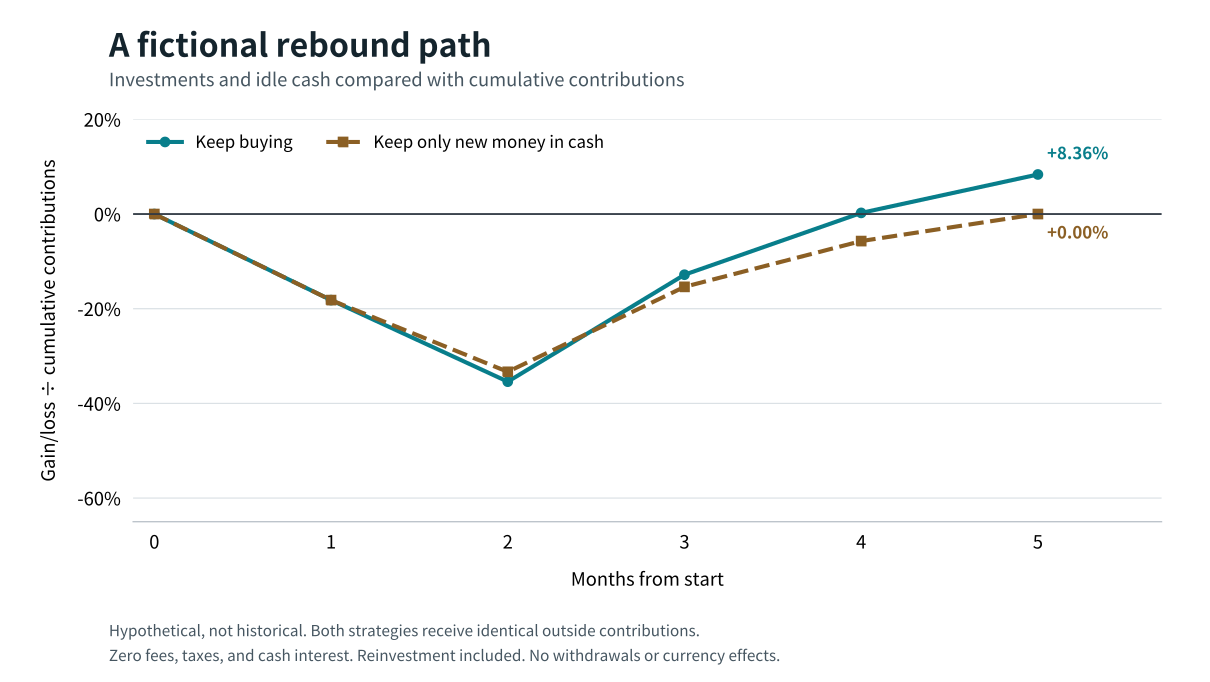
At month 3, A's balance exceeds its initial $1,000. But A has contributed $1,300 and still has a $166.67 loss, or 12.82% of contributions. Calling that balance “recovered” without specifying the denominator would blur deposits and investment results.
At month 4, A's combined value exceeds contributions by $3.33. The unit price remains 8% below its starting level. In this particular path, the additional units acquired at lower prices participate in the rebound, and A reaches nominal contribution break-even before B.
Expand the diagram
Scroll within the diagram horizontally; arrow keys work when focused.
This is not a comparison with selling the entire portfolio. B retains the starting position throughout. We have not tested a sell-and-reenter strategy.
An extended decline gives a different result
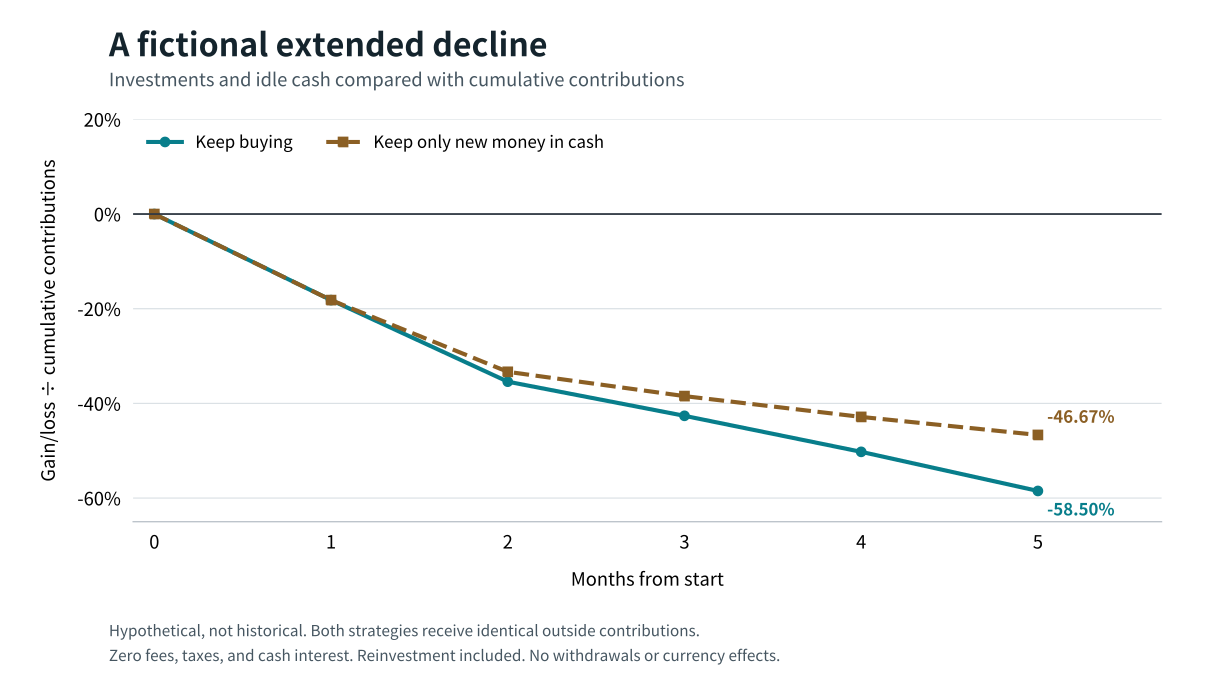
Lower purchase prices do not stop subsequent losses on the additional units. Keep every other assumption unchanged, but use unit prices of $100, $80, $60, $50, $40, and $30.
At month 5, both investors have contributed $1,500. A has $622.50, while B has $800 including cash. Losses are 58.50% and 46.67% of contributions respectively. Neither has recovered, and continuing purchases has produced the larger loss at that point.
Expand the diagram
Scroll within the diagram horizontally; arrow keys work when focused.
These two paths demonstrate dependence on subsequent prices. They do not establish that continuing contributions always produces an earlier recovery. Broad diversification can address concentration, but does not eliminate market-wide losses. A fallen individual company may never regain its old price. SEC on asset allocation and diversification
What a historical recovery claim would need
This article does not calculate recovery dates for any actual crash. To test such a claim, specify the starting date, opening holdings and contribution basis, deposit dates and amounts, and any sale or restart rules. Include the cash that an investor did not invest and the interest it earned.
Also identify the index, treatment of dividends, measurement currency and exchange rates, fees, taxes, recovery definition, and observation window. Report cases still underwater at the end. Choosing restart dates after seeing the rebound introduces hindsight that a real investor would not have had.
A comparison that gives one investor more outside money, or omits the other's saved cash, answers a different question. And a dollar index recovery does not establish the same recovery date for an investor measuring wealth in yen.
Make today's decision from facts you can check
Before the next purchase, write down whether the concern is an actual cash shortfall, a changed time horizon, an unsuitable investment, or fear triggered by falling prices. Those problems need different responses.
Continuing an affordable plan can preserve a long-term commitment. Reducing contributions to protect necessary spending can also be responsible. Neither choice needs a prediction of the exact market bottom, and neither comes with a guaranteed recovery date.
Sources checked October 12, 2026. This article provides general information and financial education, not individualized investment advice. Investing involves risk, including loss of principal. Past performance and hypothetical examples or simulations do not guarantee future results. Final investment decisions remain the investor's responsibility after considering personal circumstances and reviewing relevant product disclosures.