What do you actually own when you buy a fund?
Open one candidate fund’s official page and find three things: its assets, its investment strategy, and its currency policy. If it tracks an index, identify that benchmark too. Those tell you more about the risks you take than the number of funds in your account. A fund holding stocks around the world can still fall when stock markets decline together. “Global” describes a geographic reach; it does not tell you everything about the investment.
Look past the label
Imagine finding two products described as diversified global funds. This is a made-up example: one invests mainly in stocks, while the other combines stocks and bonds. The shared label does not make them interchangeable. Before comparing their recent returns, you need to know what produces those returns.
Start with the asset class. Are you looking at shares of companies, debt issued by governments or businesses, or a mixture? Then ask which markets and kinds of companies the fund covers. Treat an unanswered question as something to investigate, rather than filling the gap with a familiar-sounding name.
A fund also has its own structure. The SEC’s ETF introduction explains that investors pool money and that an ETF share represents an interest in its portfolio. Buying the ETF does not place every underlying company’s stock separately in your brokerage account. You own fund shares whose value is connected to the investments inside.
A benchmark is a target, not the product
An index applies a set of rules to measure a market. An index fund is an investment product that aims to follow it. You cannot buy the index itself. According to the SEC’s index-fund guide, funds may hold all the index securities or a sample; costs and implementation can make returns differ.
That distinction helps with a common reading mistake. A list of index constituents describes the benchmark. A list of fund holdings describes the portfolio at a stated time. Similar lists are not proof that every position and weight is identical. Neither a larger holdings count nor a closer-looking list, on its own, settles which product meets your needs.
For instance, the MSCI ACWI factsheet, dated September 30, 2026, describes developed- and emerging-market large- and mid-cap stocks. It does not promise exposure to every public company, every country, or every asset class. Its scope matters more here than memorizing a constituent count that can change.
Read a dated US disclosure example
The iShares MSCI ACWI ETF, ticker ACWI, is a document-reading example, not a recommendation. The product page was checked on October 12, 2026; the prospectus example below has its own stated date. Neither is a complete, real-time inventory of the fund. On its US product page, the asset class is equity and the benchmark is MSCI All Country World Index (Net). The page separates holdings, geographic exposure and sectors, with dates alongside the information.
Its summary prospectus dated November 28, 2025 describes representative sampling. The fund may therefore omit some index components. That dated prospectus also permits certain other instruments and cash. These are reasons to read the actual strategy and holdings rather than assuming the index is an exact inventory of the fund. The issuer’s regulatory-document list also links the full prospectus and Statement of Additional Information, or SAI. Read their supplements along with the summary; the summary’s cover date alone does not establish the age of the entire disclosure package.
Follow the chain: you hold ETF shares; the fund holds investments; those investments create exposure to companies and markets. A similar benchmark name does not establish that another product has the same structure or portfolio.
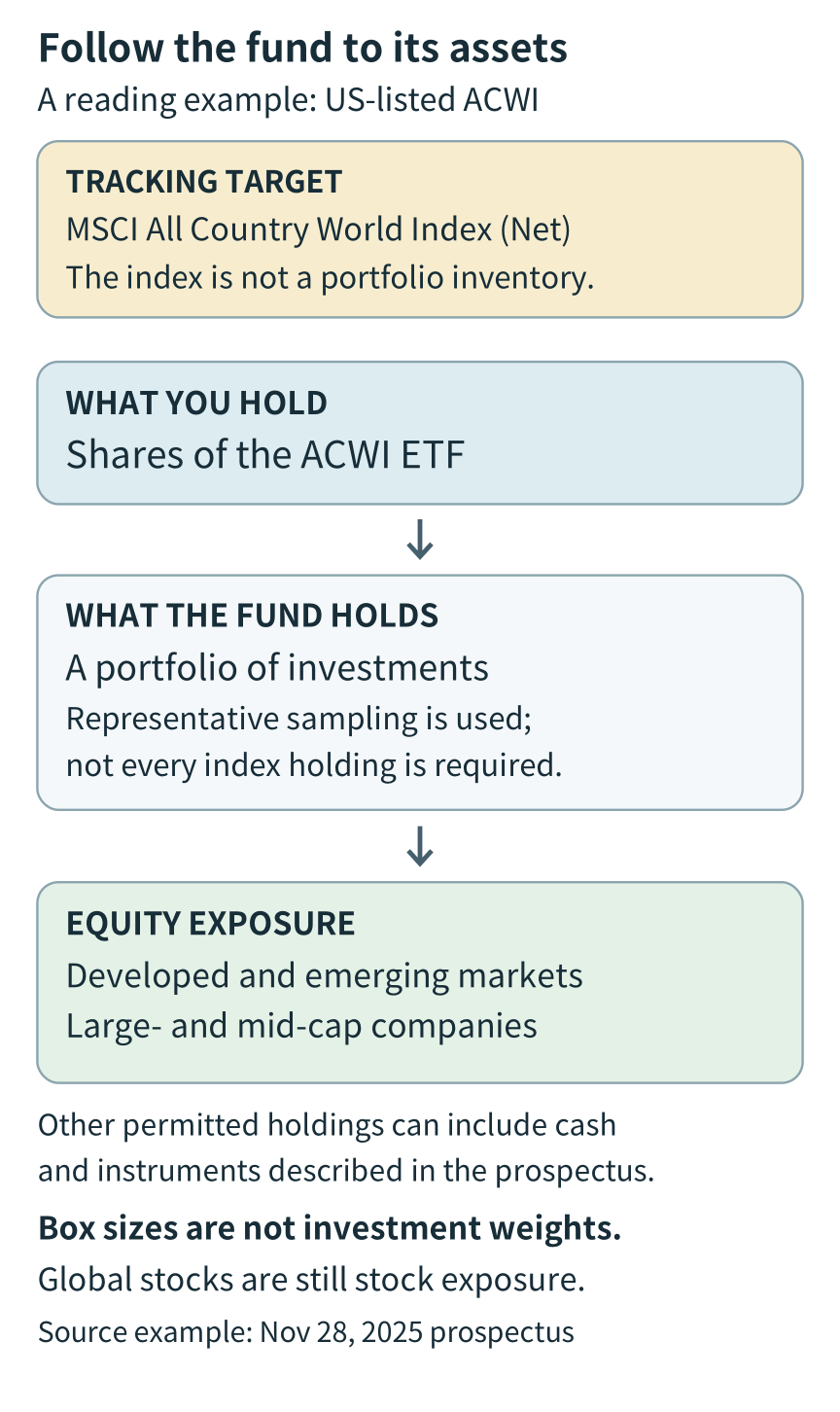
Expand the diagram
Scroll within the diagram horizontally; arrow keys work when focused.
Figure: A conceptual reading path, not a complete holdings list or an allocation chart.
Check what the percentages describe
On a holdings page, look for the observation date and the definition of the percentages. A country breakdown and a sector breakdown classify the same investments in different ways. Adding those two sets together would double-count them.
The ACWI page explains that geography principally follows issuer domicile, with some classifications reflecting where a business operates. This is not a breakdown of customers or sales. A company classified in one country may sell worldwide; that does not make its shares equivalent to owning every foreign stock market.
A top-holdings list is also only part of the portfolio. Read whether the count includes cash, derivatives or multiple share classes before comparing it with another provider’s number. Here, no current holdings counts or portfolio weights are used to rank funds.
Currency and trading price need separate checks
Paying US dollars for an ETF does not remove currency exposure within its investments. The November 2025 ACWI summary prospectus explains that a fall in a non-US currency against the dollar can reduce its dollar-denominated net asset value. The currency in which you trade and the currencies affecting the portfolio answer different questions.
For any candidate described as currency-hedged, find its stated target currency and hedging policy. Do not infer a hedge from the trading currency alone. Hedging addresses currency movements; it does not establish protection from falling stock prices. A fund’s own risk disclosures remain necessary.
For an ETF, also distinguish net asset value, or NAV, from the exchange price. NAV reflects the fund’s assets less liabilities per share. The exchange price is what buyers and sellers trade at and can be above or below NAV. The SEC’s ETF guide explains this difference. It matters even when you understand the portfolio perfectly.
Turn the research into one sentence
Write: “This fund mainly owns ___, its strategy is ___, and its currency policy is ___.” For an index fund, include its tracking target. Add the document date. If a blank remains, you have found your next question.
Then read the sentence without the fund’s marketing name. Does it describe the type of investment you meant to research? Global stocks provide diversification within stocks; they do not automatically supply bonds or accessible emergency savings. Understanding that boundary is a useful result even if you decide to wait.
Sources checked October 12, 2026. The named example uses the November 28, 2025 summary and full prospectus, the full prospectus’s February 13, 2026 supplement, and the issuer-linked SAI including its September 11, 2026 supplement. The latter updates intermediary-payment disclosures; it does not change the investment-scope or sampling statements used here. Holdings and product terms can change. Use the issuer’s current documents for a product decision.
This article provides general financial education and information, not individualized investment advice or a recommendation to buy, sell, or adopt a particular allocation. Investing involves risk, including loss of principal; stock prices and currency movements can cause losses. Diversification does not guarantee a profit or prevent loss. Past performance and fictional examples do not guarantee future results. Review current official documents and your own circumstances, seek qualified professional advice when appropriate, and remember that you are responsible for your final investment decisions.