Extra AI computation can produce more candidates, explore intermediate choices, and evaluate or revise an answer. Use reasoning when known constraints need combining, retrieval when facts are missing, and verification when the result needs checking. Waiting longer, or receiving a longer answer, does not tell you which of those jobs happened.
Three problems that need different next steps
Imagine arranging a meeting for three people. The request sounds simple, but the useful next step depends on what is missing.
You have everyone's availability. Supply travel and preparation constraints, then ask for a workable arrangement. This is a reasoning problem.
One person's current schedule is missing. Obtain it from the person or an authorized calendar. Additional reasoning cannot establish an unknown appointment.
You have an arrangement but doubt it fits. Compare it with the original schedules and check overlaps and preparation time. This is verification.
Our meeting is an invented example, not a model test. It illustrates why “think harder” can be an incomplete instruction. A real task may need all three stages: collect information, work out a solution, then check it.
Training compute and answering compute
Training uses computation to adjust a model's parameters from data and feedback. Inference uses a trained model to respond to an input. “Test-time compute,” in this research context, concerns the latter stage.
OpenAI's September 2024 introduction to o1 distinguished additional reinforcement-learning training from additional computation during an answer. That is a historical research example, not a guide to today's products, plans, or model choices.
Reworking a proposed meeting during a conversation does not require retraining the whole model. New constraints can become part of the input it uses. That also does not mean your correction has immediately become a learned fact in the model used by everyone else.
More than one way to spend the budget
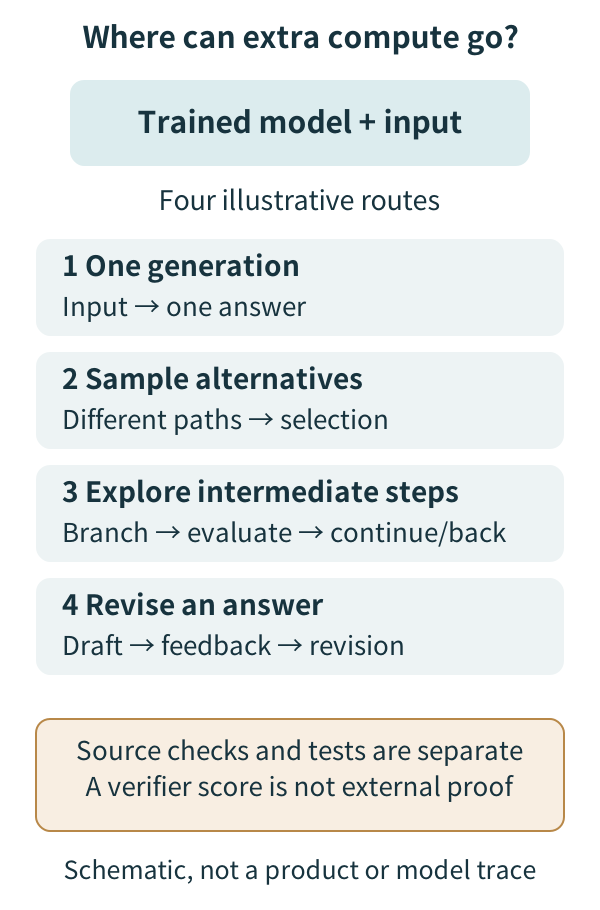
One approach is to generate several candidates. The Self-Consistency paper samples different reasoning paths and uses agreement among their resulting answers. An alternative path may succeed where the first attempt failed.
For our meeting, imagine making one plan around the earliest opening and another around the shortest travel gap. These are illustrative strategies, not claims about how a particular chatbot works. If both plans start from the same incomplete calendar, both can miss the same appointment. Agreement is not independent evidence about an outside fact.
Another approach is to search through intermediate choices. Tree of Thoughts explores and evaluates intermediate possibilities, with lookahead or backtracking. Instead of finishing every candidate before comparison, a system can spend work deciding which partial paths deserve further attention.
A third approach is to revise an initial answer. In Self-Refine, the same model generates feedback and uses it to improve its output iteratively. In our illustration, noticing a missing preparation period could lead to a revised schedule. Whether the criticism is sound still matters.
Original explanatory diagram created for this articleExpand the diagram
Scroll within the diagram horizontally; arrow keys work when focused.
This original schematic organizes published methods. It is not a recorded model run, a description of any product's undisclosed internals, or a claim that all four routes operate together.
A verifier's score is one kind of checking
A model that evaluates candidates is often called a verifier. Let's Verify Step by Step studied supervision of intermediate steps in mathematical solutions, rather than only the final result. Evaluating steps can help identify promising or problematic paths.
But a learned evaluator's approval is different from an independent check. Another AI saying that a meeting plan looks sensible does not establish that it read the participants' calendars. Its judgment can also be wrong.
For a result you intend to use, ask what the checking actually involved. Was the proposal compared with the original source? Were the stated constraints checked? Was an applicable test run? A detailed explanation may help you inspect an answer, but it does not replace those checks.
The experiments focused on mathematics. Estimating difficulty also has a computational cost, which the paper says its comparisons did not account for. Its results therefore do not establish that giving any model more time will solve every kind of question. They show why the way a budget is spent deserves attention.
Elapsed time is an especially rough signal. Network delays and service load can contribute to a wait. Meanwhile, the visible response does not disclose how many candidates were considered or how they were evaluated. A concise answer can follow substantial computation; a long answer alone is not proof of rigorous checking.
Ask for the work you need
Instead of only requesting more thought, make the deliverable inspectable: “Propose two schedules using these constraints, briefly explain the rejected option, and flag any unavailable information.” Then request a final comparison against the original constraints.
You do not need a transcript of private internal reasoning to benefit from this. Alternatives, relevant assumptions, evidence, and a concise explanation of the decision give you something practical to review.
For the meeting, a useful answer might identify a feasible slot and one unresolved availability check. That unresolved check is valuable information. It tells you exactly what remains before sending invitations, rather than burying uncertainty inside a polished recommendation.
Extra reasoning is useful when better use of existing information can reveal another path. Missing information calls for retrieval; an answer you will act on calls for appropriate verification. Distinguishing those jobs makes the “thinking” label easier to interpret.
The related article on confident wrong answers explores the separate question of fluent language and factual support.
Sources and limits
Primary sources checked October 11, 2026, Japan time. This is a principles explainer, not a hands-on service comparison. Recheck if cited research is corrected or model-specific claims are added.