What does 10,000 mAh mean, and how many charges can you expect?
A 10,000 mAh power bank and a 4,000 mAh phone look like an easy division: two and a half charges. For a useful estimate, compare their energy in watt-hours, then account for losses along the charging path. When choosing a bank, check stored energy, compatible power output, and the weight you will actually carry.
Start with the gap in your day
Do you need enough energy to get home, or a full day away from an outlet? An evening top-up does not require the same reserve as repeatedly charging from empty. Decide what shortfall you want to cover before comparing the biggest number on the box.
For a bank you own, look at its label and manual. Find the battery rating, any Wh figure, and the separate output specifications. For a prospective purchase, open the specifications rather than relying on the product name. Look for your phone's battery energy in the manufacturer's information, too. If a rating is missing, ask about the exact model instead of borrowing a voltage from another device.
Give mAh its matching voltage
Milliamp-hours measure electric charge. Divide by 1,000 to convert mAh into amp-hours, then multiply by the corresponding nominal battery voltage to obtain the rated energy in watt-hours:
Wh = mAh ÷ 1,000 × nominal voltage in V
A hypothetical 10,000 mAh battery rated at 3.7 V holds 37 Wh. A 5,000 mAh battery rated at 7.4 V also represents 37 Wh. Half the mAh does not necessarily mean half the energy when the voltage differs. The FAA's explanation of watt-hour ratings gives the same conversion method.
The 3.7 V value belongs to this example. It is not universal. Cell chemistry, cell arrangement, and the manufacturer's labeling convention matter. Do not multiply an advertised sum of cell capacities by a pack voltage from a different line. Prefer the manufacturer's stated Wh rating when available. Nominal voltage is a reference rating, not a claim that the battery remains at that voltage throughout discharge.
Why the USB voltage changes the number
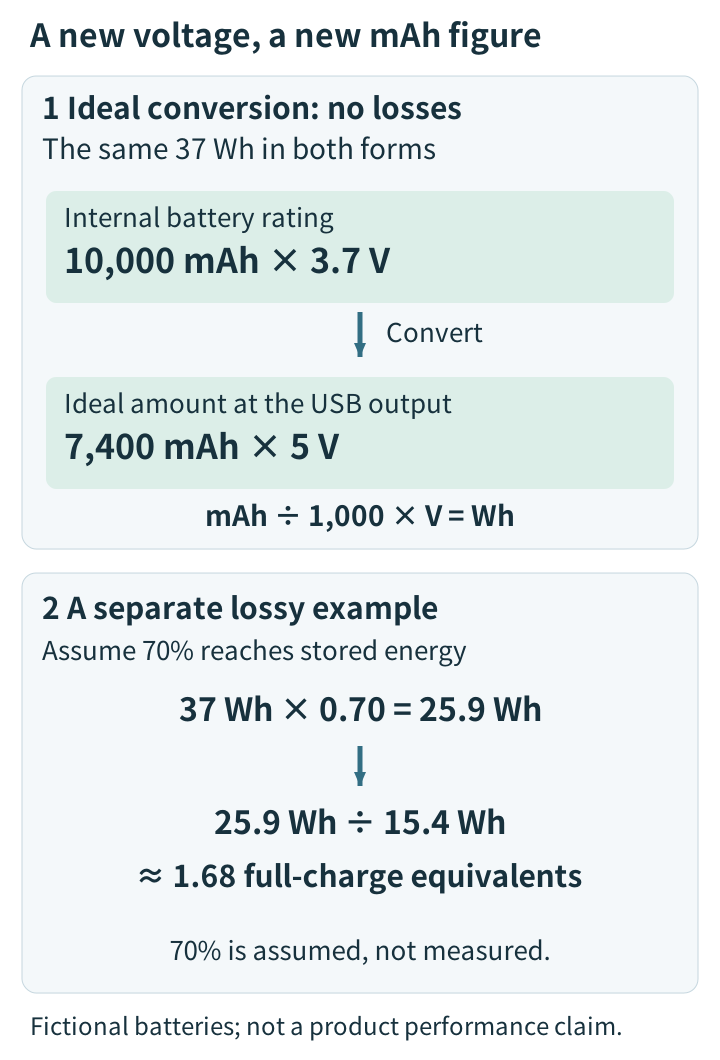
The cells and the USB port operate at different points in the charging path. A bank rated internally at 3.7 V may provide 5 V at its port, or negotiate other supported voltages. Multiplying its internal 10,000 mAh by the port's 5 V mixes two different ratings; it does not turn 37 Wh into 50 Wh.
First imagine an ideal converter with no losses. At 5 V, the same 37 Wh corresponds to 7.4 Ah, or 7,400 mAh. The mAh number became smaller, but no energy disappeared: the voltage changed.
Real conversion adds another change. Energy is lost in the bank's circuitry, the cable, and the phone's charging system. A phone running navigation or video also uses some incoming energy rather than storing it. Anker's explanation of the charging path distinguishes bank-side conversion from device-side charging losses. Its sample efficiencies are not a specification for every bank.
Read any “rated capacity” figure together with its voltage and test conditions. An output-side rating and an internal-cell rating can legitimately differ. The heading alone is not enough to identify what was measured.
A worked example, with invented inputs
Here is a calculation to show the method, not a test result or a promise about products on sale:
Power bank: 10,000 mAh at 3.7 V, giving 37 Wh
Phone battery: 4,000 mAh at 3.85 V, giving 15.4 Wh
Assumption: 70% of the bank's rated energy ultimately becomes stored energy in the phone battery
The result is 37 × 0.70 ÷ 15.4, or about 1.68 full-charge equivalents. The assumed 70% already covers the entire path from the bank to stored phone energy. Do not subtract the same conversion losses again.
This does not guarantee one full charge followed by exactly another 68 percentage points on the screen. Starting charge, temperature, battery condition, charging method, and phone activity affect the outcome. The example simply divides one assumed amount of usable energy by another battery's rated energy.
If a manufacturer advertises a number of recharges, check which phone and conditions it used. A result for a powered-off phone is not automatically a result for a day of photography and maps. Where efficiency is unknown, a precise-looking decimal is a poor substitute for a sensible reserve.
Convert a matching capacity label to Wh
Use mAh and nominal voltage for the same battery. Do not pair internal-cell mAh with a USB output voltage such as 5 V. Prefer the manufacturer’s Wh figure when available.
Inputs are calculated on this page; they are not saved or sent.
The interactive calculation needs JavaScript. The original article’s formulas and worked examples remain readable.
Read the battery capacity label.
Do not assume every product uses 3.7 V.
Enter your values, then calculate.
Optional: compare full-charge equivalents with assumed losses
This uses an assumed entire-path efficiency. It does not promise recharge counts for a product with unknown efficiency.
Prefer the manufacturer’s stated Wh.
Use digits and a decimal point, without commas or exponents.
0–100%. The example’s 70% is hypothetical, not universal.
Enter your values, then calculate.
Wh × assumed efficiency ÷ phone battery Wh. Losses are included once. This is not a measured recharge count, a power rating in W or permission to fly with a battery.
Watts answer a different question
Wh describes an amount of energy; W describes the rate of energy delivery. A 30 W output claim is not a 30 Wh capacity claim. It tells you about a power level the bank can support under the stated conditions.
For an output mode, volts multiplied by amps gives watts: 9 V at 2 A is 18 W. Several modes printed on a label are alternatives, not numbers to add together. Check the device's charging requirements, cable compatibility, and the power available when multiple ports are occupied. Anker's guide to label markings separates input, individual output, and total output.
A bank can have enough energy for your purpose yet supply it too slowly for a busy device. Conversely, a high maximum output does not guarantee a large reserve. Keeping the two questions separate helps you avoid buying for the wrong problem.
Choose something you will carry
Compare Wh and supported output first, then check the dimensions and combined weight of the bank and necessary cables. A top-up you need every afternoon deserves different priorities from reserve energy you will carry occasionally. A percentage display is useful, but it is not a precise count of future phone charges.
Do not continue testing a bank that is swollen, deformed, or unusually hot. Stop using it and follow the manufacturer's support guidance; Elecom's current safety notes identify these as warning signs. Ordinary use of an undamaged bank can help establish whether it covers your routine without deliberately draining everything to zero.
For a flight, a Wh calculation is not permission to carry or use the bank. Check the FAA guidance and your operating airline’s current quantity, storage, and charging rules for the route. Delta’s conditions are one carrier’s example, not a worldwide rule.
The practical habit is simple: whenever you see mAh, find the matching voltage and Wh. Then ask whether the output and the weight fit the day you actually have.