How close are AI robots to doing household chores?
Robots can increasingly connect visual information and spoken instructions to useful actions. A successful demonstration still does not establish that you can hand over your household chores. The intriguing advance is the loop: see what happened, adjust the next action, and sometimes ask for help. Start by separating an AI model, a demonstration system, and a supported household product.
First, identify what is actually being announced
A humanoid picks something up from the floor, and it is tempting to imagine one clearing your living room. Before checking your furniture layout, check the announcement.
- A research model is software that interprets inputs or produces actions. It is not the robot's body.
- A demonstration system combines software, hardware, controllers, and a particular operating environment.
- A household product needs defined tasks, installation conditions, maintenance, and ways to stop it, alongside an actual offer to customers.
In its July 30, 2026 announcement, Google DeepMind presents Gemini Robotics 2 work on whole-body movement and dexterous manipulation. Access to its action and on-device models is through early-access partners. This article examines that dated research example; it is not a US shopping guide or a survey of the newest products across robotics.
What is hidden inside “put that mug away”?
Imagine a mug, a paperback, and a small plate on a kitchen table. You want the mug moved to the sink. This is an explanatory scenario, not a recorded demonstration.
The system must identify the intended object and destination. Two similar mugs make even that first choice less obvious. It then needs a workable grasp, a route that avoids the book, and a way to carry and release the mug. Recognizing a handle does not establish that the robot's fingers will fit through it.
Vision-language-action, or VLA, models connect visual observations and language with robot actions. The original 2025 Gemini Robotics paper investigates changing objects, arrangements, instructions, and environments. That is the useful meaning of generalization here: how far learned capabilities carry beyond familiar examples. It is not a synonym for working in every kitchen.
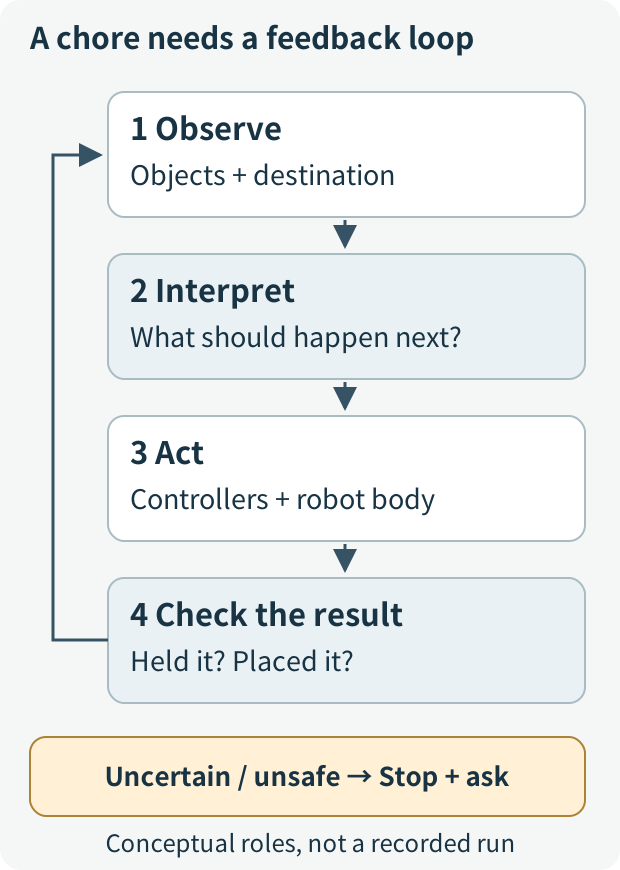
Expand the diagram
Scroll within the diagram horizontally; arrow keys work when focused.
Figure: An original conceptual loop for understanding a chore. The four boxes describe roles, not the undisclosed architecture or fixed processing sequence of a commercial model.
Move the book closer to the handle or place two mugs together. A small change can require a different grasp or a question about which object you mean.
The next action depends on the last one
Suppose the mug slips during the grasp. Replaying the rest of a preselected movement would not solve the task. The robot needs to establish whether it is holding the mug before carrying it, and whether the mug has been placed before withdrawing.
Google's ER 2 developer explanation describes using video to track progress and failures while coordinating multiple steps. It presents a division between interpreting the situation and invoking lower-level action capabilities. Other systems may organize these roles differently.
The ER 2 model card lists access through Google AI Studio and the Gemini API, plus a private preview on Gemini Enterprise Agent Platform. Access is subject to terms, including a ban on safety-critical uses. Its output is text. That matters: the reasoning model does not independently turn a motor or regulate gripping force. A working system also needs the appropriate control interfaces and hardware. A convincing explanation of how to carry a cup is not evidence of controlled physical contact.
A different home is a different test
Think about changing the table height, the clutter, the available space, or the meaning of “away.” A household might mean the dishwasher, a drying rack, or a cupboard. These are questions to put to a demo, not failures we have observed in a named robot.
The On-Device 2 model card lists numerical robot actions as output and distribution only to Trusted Testers. It identifies limits in unfamiliar tasks and control of robots with many degrees of freedom. It also says its evaluation primarily concerns stationary, two-arm manipulation; risks from mobile platforms and whole-body control fall outside that scope. Do not transfer one model's evaluation boundary to every member of the model family.
Running locally is another, separate dimension. Removing a network round trip cannot by itself resolve an ambiguous instruction or establish success on an unfamiliar object. Where computation happens and what the system can reliably do are different questions.
Asking for help is part of the job
Constant intervention would reduce the convenience of a household robot. But a system that never asks questions could also press ahead when it should stop. Useful assistance needs both independence and sensible boundaries.
Google's robotics safety report evaluates instruction refusal, clarification, and protective stopping. It combines offline benchmarks, including emulated action-tool responses, with real-robot stopping tests. These are different evidence types, not a set of general-household chore trials. It explicitly excludes evaluation of the underlying functional-safety architecture, including certified hardware and redundancy. Those research results therefore do not certify an assembled robot for unsupervised domestic use.
For the imagined mug task, ask what happens if a person steps into the route. Who can stop the system, and what does stopping actually do? Those questions belong beside the impressive grasp, not in a footnote after it.
Teleoperation means a person directs the robot during the operation. Human demonstrations used for training are a separate issue from human control during an evaluation. Check the paper or demonstration notes for the autonomous portion and any intervention; the video alone may not settle this.
Five things to look for in the next video
- Task: rigid objects, flexible laundry, or something else? Do not infer unshown abilities.
- Environment: a new home, a familiar room, or a prepared test area?
- Human involvement: remote operation, setup, resets, or instructions along the way?
- Success measure: one action or the complete chore? Are total attempts and failures reported?
- Ending: verified completion, recovery from a mistake, or a safe stop?
If the publication does not answer a question, leave it unresolved. A demonstration can be a genuine research advance without establishing everyday reliability. The exciting part is language becoming physical action. The next threshold is completing useful work through the variations, interruptions, and uncertainties of someone else's home.
Sources rechecked October 11, 2026 (UTC): the July 30 announcements, both model cards, the safety report, the 2025 paper v1, and the Robotics section of the official model-card index. This is not a hands-on review or long-term household trial. No reliability rate, consumer price, or launch date is inferred. Recheck research and access conditions before publication.