Which iPhone to Buy in Fall 2026
A US guide to iPhone 18 Pro, Duo, 17, 17 Pro and 17e
Prices and availability checked October 11, 2026
Start with iPhone 17 for everyday use, choose 18 Pro for a specific camera or creative need, and consider Duo if you regularly want two apps open side by side. The 17e is the lower-cost choice for the basics. If your current 17 or 17 Pro still does what you need, keeping it is a sensible answer too.
Apple’s current US lineup lists 18 Pro and Pro Max, Duo, Air, 17, 17e and 16. There is no standard iPhone 18 or SE in that lineup, so the relevant mainstream comparison is with 17 and 17e. As checked on October 11, 2026, Duo was still prerelease: Apple announced US preorders for October 16 at 5 a.m. Pacific and availability for October 23. Both dates are still future plans at this check. Current lineup · Duo ordering dates
The Shortlist
| Pick | Best reason to choose it | Main compromise | 256GB outright price |
|---|---|---|---|
| iPhone 17e | Keep the cost down for calls, messages, maps and ordinary photos | No ultrawide camera or ProMotion | $699 |
| iPhone 17 | A well-rounded everyday phone without Pro weight | No dedicated telephoto | $929 |
| iPhone 18 Pro | Distant subjects, camera control and production workflows | $270 more than 17 and 34g heavier | $1,199 |
| iPhone 18 Pro Max | A larger screen and more battery headroom | A 6.9-inch, 249g phone to carry | $1,299 |
| iPhone Duo | Read, compare and work across two apps | Prerelease at the check date; price, bulk and camera trade-offs | $1,999 |
Prices are Apple US, before sales tax, trade-in or accessories, with no carrier connection required at purchase. The 17’s advertised $899 includes a qualifying $30 connectivity discount; “connect to any carrier later” costs $929. That activation discount is separate from a carrier’s installment, trade-in or bill-credit promotion. 17e · 17 · 18 Pro and Pro Max · Duo
This is a buying guide based on published specifications, not a hands-on camera or battery test. The recommendations below explain which differences are worth paying for.
Why iPhone 17 Is the Starting Point
The 17 already has a 6.3-inch OLED display with up to 120Hz ProMotion and Always-On. You do not need to buy a Pro simply to get smoother scrolling. At 177g, it is also lighter than the equally sized 18 Pro. Those are things you interact with every time you pick up the phone. 17 specifications
Its main and ultrawide rear cameras cover ordinary snapshots, tight indoor spaces, scenery and macro subjects. The 18MP Center Stage front camera adds flexibility for selfies and video calls. For a trip, a meal or people standing nearby, this is a more useful starting point than assuming the most expensive camera system is necessary. 17 camera overview
The limit to consider is distance. The 17’s 2x option uses the main sensor; it is not a separate telephoto lens. If you repeatedly wish you could get closer from the bleachers or the back of a room, that is a concrete reason to consider a Pro. If most photos are at 1x or ultrawide, the $270 upgrade deserves a second thought.
What the 17e Saves and What It Leaves Out
The 17e saves $230 against a connect-later 17. It has A19, Face ID, USB-C and MagSafe/Qi2 charging up to 15W. Its 6.1-inch display and 169g weight also make it a relatively compact option within this group. For someone who mostly communicates, navigates, pays and takes straightforward pictures, it can be enough. 17e specifications
What you give up matters more than the chip name: no ultrawide or macro camera, no ProMotion, no Always-On display, no Dynamic Island and no Camera Control. Its 12MP TrueDepth front camera is different from the 17’s 18MP Center Stage camera. Compare scrolling and front-camera operation in a store before deciding that none of those things matter to you. Apple’s model comparison
Coming from an SE? The 17e does not preserve its Home button or Touch ID. It fills the lower-price role in this comparison, rather than reproducing the SE experience. If familiar controls are your priority and your current phone still runs the apps you need, first compare keeping it, including any needed battery service, with the cost of changing phones.
When the Extra $270 for 18 Pro Makes Sense
There are three strong reasons to move up from 17.
First is a dedicated 4x telephoto camera. The 8x setting is optical-quality sensor cropping, not a separate 8x lens. Second is a variable-aperture main camera with four settings, from f/1.48 to f/4.0, adding control over light and depth of field. Third is a production workflow: ProRAW, ProRes RAW, Apple Log 2 and faster USB 3 file transfer. Those capabilities have a purpose if you edit and move large files, rather than just share finished clips. 18 Pro specifications
Variable aperture is a useful creative option, but it does not prove that every photo will be better or every moving subject will be sharp. If you are buying to solve a particular problem, such as indoor sports, look for real sample comparisons from that situation. Specifications can identify the tools; they cannot settle image quality on their own.
A20 Pro and the updated cooling design also deserve attention if your phone spends sustained time gaming or processing demanding work. For messaging, maps and watching video, those changes alone are a weaker reason to spend more. Apple’s 18 Pro announcement
Pro Max Is Mostly a Size and Battery Decision
The two 18 Pro models share their principal rear-camera system. Choose the Max for its 6.9-inch display and longer rated endurance, not because you assume the smaller Pro lacks its main camera features. The extra cost is $100; the weight rises from 211g to 249g. If you read one-handed in bed or carry your phone in a small pocket, try that size before treating it as an automatic upgrade. 18 Pro and Pro Max specifications
Duo Is for People Who Will Use the Inner Screen
At $1,999, Duo costs $800 more than 18 Pro and $700 more than Pro Max. Its strongest argument is not a higher place in the camera hierarchy. It is a 7.6-inch folding display with Split View for two apps, including moving a photo into an email beside it. Duo overview
Think about how often you switch between a document and notes, a travel plan and a map, or a photo library and a message. If you do that repeatedly away from a desk, the larger working area may be valuable. If you mostly open one social app at a time, you may pay for a screen you rarely unfold. Check your essential apps’ layouts and behavior rather than assuming every app will make equally good use of the space.
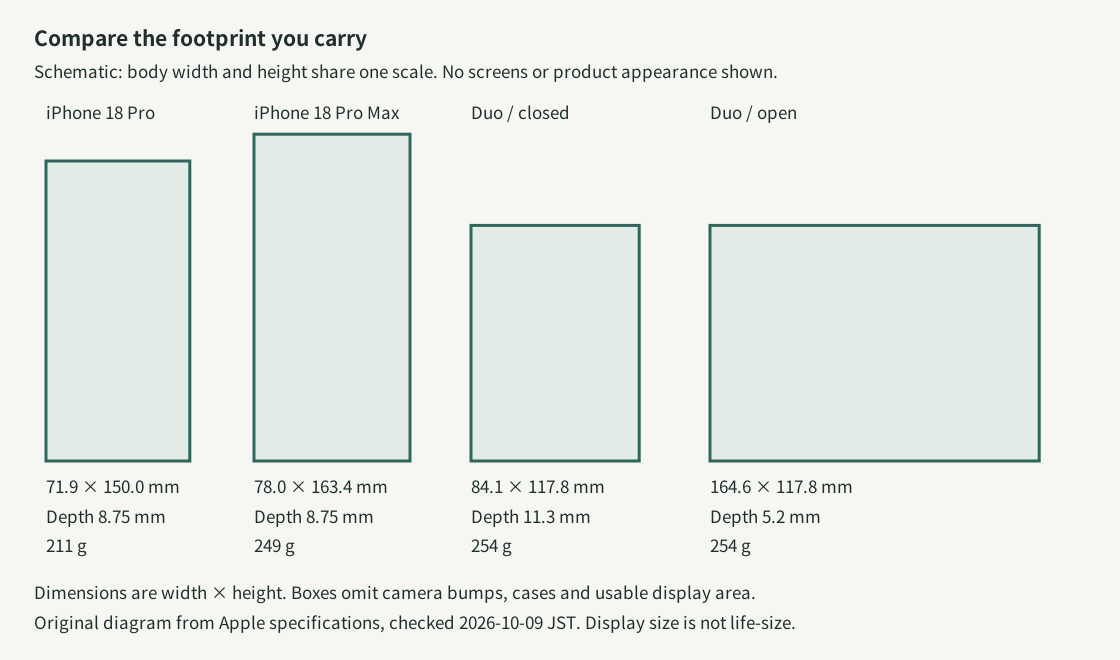
Duo weighs 254g. Folded, it is 84.1mm wide and 11.3mm thick: shorter than Pro Max, but wider. The headline thinness when open is not the thickness that goes into your pocket. Test the closed-screen keyboard, grip and opening motion as well as the large display. Duo dimensions
Expand the diagram
Scroll within the diagram horizontally; arrow keys work when focused.
At a shared scale, closed Duo is 45.6mm shorter than Pro Max, but 6.1mm wider and 2.55mm thicker. The rectangles compare body dimensions, not usable display area or measured comfort. Apple Pro/Pro Max dimensions · Duo open and closed dimensions
The Features You Give Up From a Pro
Duo has main and ultrawide rear cameras, but no dedicated telephoto and no variable aperture. It uses side-button Touch ID rather than Face ID, lacks an Action button, and has a 12MP outer front camera plus an under-display FaceTime camera inside. These are meaningful changes for a Pro owner, regardless of the higher price. Duo technical specifications
Its different shape also creates different opportunities: Duo Preview lets the subject see the framing, and the phone can stand for hands-free uses. That can matter more than zoom for someone who wants to join the picture instead of always taking it. Apple’s Duo announcement and photographs
As of our October 11, 2026 check, Apple planned Apple Pencil (USB-C) support later in 2026; actual availability has not been verified. Do not buy on the assumption that handwriting support will be available on release day. Apple’s Pencil availability note On October 11, Duo was also still a prerelease purchase decision, without an established long-term ownership record. If hinge wear, display feel, repair exposure or a specific app is critical, wait for the phone to ship and evaluate those questions before committing.
See the official 18 Pro photographs and official Duo photographs for their appearance and form factor.
Already Own a 17 or 17 Pro
Keep a 17 if you are happy with its photos, display and battery. Buying 18 Pro adds a telephoto and other creative options; it is not necessary merely to keep a modern-feeling screen.
The argument for keeping 17 Pro is stronger still. It already has the 6.3-inch ProMotion display class, dedicated 4x telephoto with 8x optical-quality cropping, 18MP Center Stage front camera and USB 3. ProRes RAW and Apple Log 2 are not new reasons to upgrade from that model. 17 Pro technical specifications
The newer Pro adds variable aperture, updated camera controls, A20 Pro and improved rated endurance and charging. For the smaller Pro, Apple’s video-playback figure moves from 33 to 36 hours; weight rises from 206g to 211g. Upgrade because one of those changes answers a need you can name. If your only problem is battery wear, compare service cost before replacing the whole phone. 18 Pro specifications
Buying a 17 Pro Now Is a Different Question
17 Pro is absent from Apple’s current new-phone lineup, so remaining retailer stock, refurbished units and used phones need to be treated separately. Its original launch price is not a current offer. A lower price only helps if the particular phone’s condition and purchase terms make sense.
Look at the exact capacity, unlocked status, battery health, parts and repair history, return window and warranty. Add any expected battery service and shipping to the asking price before comparing it with a new 18 Pro. Apple advises checking those areas and avoiding devices with Activation Lock enabled. A seller’s cosmetic grade does not tell you everything about battery condition. Apple’s preowned-iPhone checklist
Judge a Used 17 Pro by Its Total Cost
This is hypothetical arithmetic, not a seller offer. Suppose an unlocked 256GB 17 Pro costs $950 including shipping and any expected battery service, before sales tax. Against the October 11 new-phone prices above, that is $249 below 18 Pro ($1,199), but $21 above a connect-later 17 ($929). No stock, seller, warranty or ability to buy at $950 has been verified.
Above $929 before tax on that same cost basis, ask whether you would pay more than a new 17 for the older Pro’s telephoto and production features. As the total approaches $1,199, the saving against a new 18 Pro shrinks. These are comparison thresholds tied to this guide’s dated new-phone prices, not used-market valuations or universal buying limits. Add the actual sales tax for each option before deciding.
Use a real quote to recalculate the difference, then decide whether the battery condition, repair history, return policy and warranty justify it. A cosmetic grade or a seller’s “refurbished” label does not establish a new battery or Apple Certified Refurbished status. If you will not use the Pro features, a new 17 may be easier to justify.
Compare Battery Figures on the Same Basis
| Model | Display and weight | Apple-rated video playback |
|---|---|---|
| 17e | 6.1 inches, 169g | Up to 26 hours |
| 17 | 6.3 inches, 177g | Up to 30 hours |
| 17 Pro | 6.3 inches, 206g | Up to 33 hours |
| 18 Pro | 6.3 inches, 211g | Up to 36 hours |
| 18 Pro Max | 6.9 inches, 249g | Up to 45 hours |
| Duo | 7.6-inch inner / 5.4-inch outer, 254g | Up to 31 hours inner / 44 hours outer |
These are Apple’s US video-playback test ratings, not measured mixed-use endurance. Test conditions also differ across generations; the 33-to-36-hour change does not guarantee three more hours in your daily use. In particular, do not judge Duo’s large-screen battery life by its outer-screen figure. 17e · 17 · 17 Pro · 18 Pro · Duo
The 18 Pro models’ approximately 15-minute charge to 50% also requires a 60W-capable or higher adapter supporting AVS. Owning a USB-C charger does not by itself mean you can achieve that figure. Check the adapter requirements before making fast charging part of the purchase argument.
Storage and the True Cost of a Deal
The price comparison uses 256GB throughout. The 17 and 17e top out at 512GB; 18 Pro, Pro Max and Duo offer up to 2TB. Apple’s model comparison
Start with current storage use under Settings → General → iPhone Storage. Then account for the games, offline media and video you intend to keep. A tidy photo library and occasional clips suggest a different capacity from extensive 4K recording. Cloud storage can help manage a photo library, but it does not expand the phone’s space for installed apps.
US carrier offers deserve a separate calculation. Compare the device price, sales tax, required service plan and the period over which credits arrive. A lower monthly phone payment can be offset by a more expensive plan. Check what happens if you change carriers or pay off the device early. Apple’s $30 connectivity discount for 17 is a much smaller and simpler distinction than a multi-year trade-in promotion. Apple’s 17 purchase terms
All five current choices in the main table use eSIM in the US. Check that your carrier and any planned travel service support the model before replacing a phone whose physical SIM you expected to move over. Apple’s Duo activation FAQ · 17e SIM specifications
Two Other Options Worth a Brief Look
Air starts at $1,099 for 256GB. At 165g and 5.64mm thick with a 6.5-inch display, it is the specialist choice for screen size with low weight. The rear camera is main-only, without an ultrawide or dedicated telephoto, and rated video playback is 27 hours. At just $100 below 18 Pro, buy it because you want that thinner, lighter shape. Air price · Air specifications
Apple also still lists 16. If a retailer offer brings it into consideration, compare the same storage size and purchase conditions against 17 and 17e. A 128GB headline price or a carrier-credit offer is not a like-for-like substitute for this guide’s 256GB outright prices. Apple’s current selection
Buy for the Problem You Have
Choose 17 for a balanced everyday phone; 17e to spend less; 18 Pro for a camera or production need; Pro Max for screen size and battery headroom; Duo for working across apps on a folding display. Keep your current phone if none of those solves a real frustration.
Apple prices, specifications and release plans were rechecked October 11, 2026. The used-phone cost example is hypothetical, not a verified offer. Recheck Duo at preorder and release, and verify Apple Pencil support before buying for handwriting. Links are ordinary references, not affiliate links.